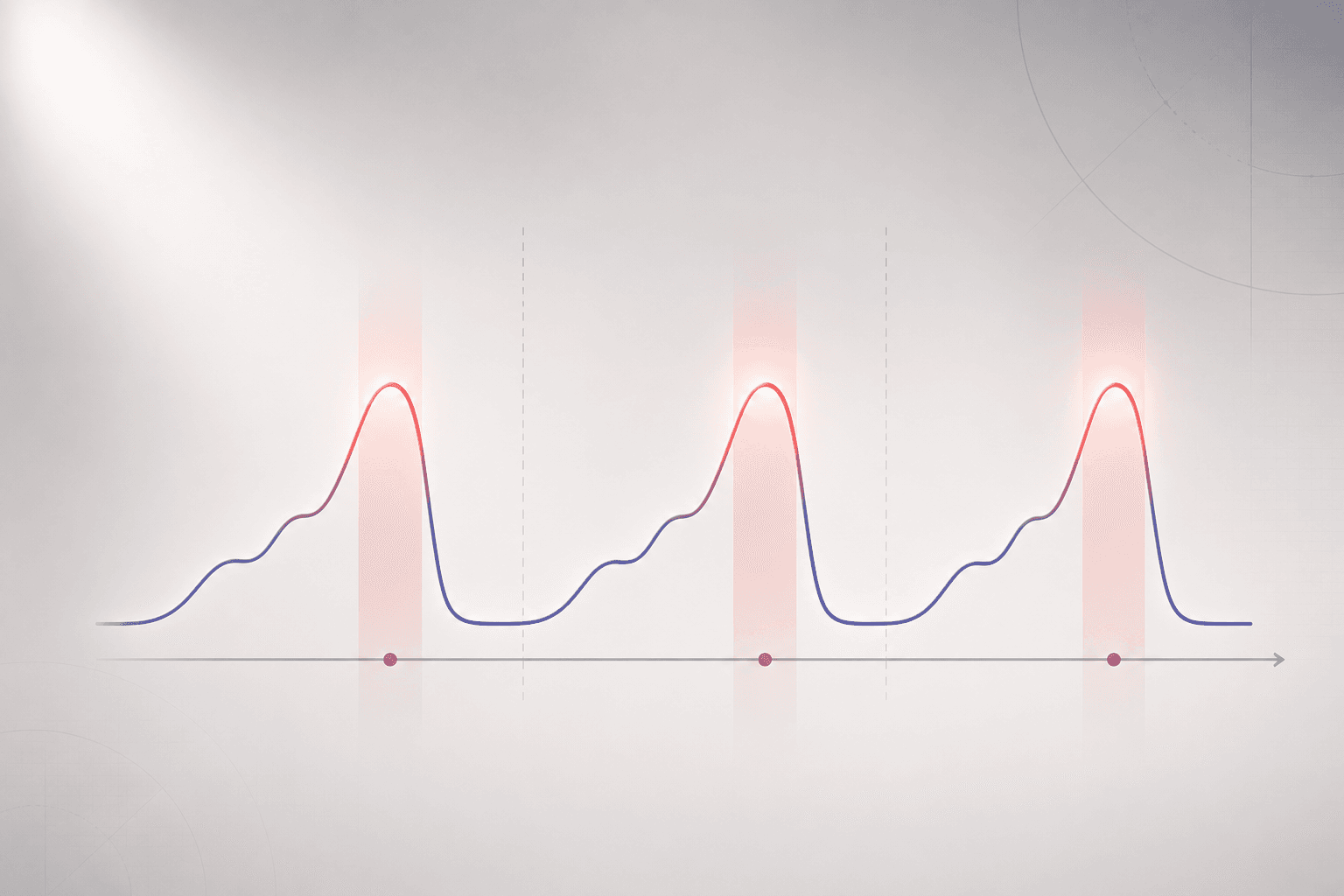
Irritability, sadness, anxiety, fatigue, poor concentration and physical discomfort are familiar experiences. On their own, none of them tells you that the menstrual cycle is the explanation.
What matters is whether these symptoms repeatedly appear before a period, ease after menstruation begins and leave a relatively better interval before returning. It also matters whether they are present throughout the month and simply become worse before menstruation, and how much they affect work, study, relationships and everyday life.
Those distinctions sit at the centre of understanding premenstrual syndrome (PMS) and premenstrual dysphoric disorder (PMDD). The difference between them depends on the pattern, severity and impact of symptoms.
When Symptoms Become Premenstrual
PMS and PMDD are defined not simply by what you feel, but by the relationship between those symptoms and your menstrual cycle.
Symptoms typically emerge during the premenstrual phase, improve around the beginning of menstruation and are followed by a relatively symptom-free interval.[1]
Feeling anxious before a period, by itself, does not establish a premenstrual disorder. Anxiety that repeatedly intensifies during the same part of the cycle and then eases afterwards may point towards one.
Timing alone, however, is not enough. The symptoms themselves—and the extent to which they disrupt your life—also matter.
What PMS Can Look Like
PMS can involve physical, emotional, cognitive and behavioural symptoms. You may experience bloating, breast tenderness, headaches, fatigue, changes in appetite or sleep, irritability, anxiety or difficulty concentrating.[1]
PMS also has a pattern-based definition. Symptoms occur during the days before menstruation, resolve shortly after it begins and should cause some degree of impairment in normal life.
Prospective daily symptom tracking can help confirm that pattern rather than relying only on memory.[1]
The difference between PMS and PMDD is not that one has criteria and the other does not. PMDD has a more specific diagnostic threshold, including a minimum symptom count and the requirement for at least one core affective symptom, and is associated with more severe distress or impairment.[2]
Repeated difficulty concentrating before menstruation can affect work or study. Irritability may strain relationships. Fatigue can make usual activities harder to manage.
For some people, these symptoms are uncomfortable but manageable. For others, they become substantially more disruptive.
When Does PMS Become PMDD?
PMDD is not simply a label for particularly unpleasant PMS. It has a specific diagnostic framework based on the type and number of symptoms, their timing and the degree of distress or functional impairment they cause.[2]
The difference can sometimes be seen most clearly in the consequences. There is a difference between feeling irritable and repeatedly becoming so angry that important relationships are damaged; between feeling low and becoming so distressed that work, study or ordinary functioning becomes difficult; and between feeling tired and repeatedly withdrawing from activities that are usually manageable.
These contrasts do not diagnose PMDD. They illustrate why severity cannot be judged simply by counting symptoms.
How PMDD Is Actually Assessed
Under the DSM-5-TR, PMDD requires five or more symptoms in the final week before menstruation, with at least one of four core affective symptoms: marked mood swings or affective lability; marked irritability or anger; markedly depressed mood or hopelessness; or marked anxiety or tension.[2]
The remaining symptoms are drawn from a defined list: decreased interest in usual activities; difficulty concentrating; lethargy or marked lack of energy; marked changes in appetite; hypersomnia or insomnia; a sense of being overwhelmed or out of control; and physical symptoms such as breast tenderness, joint or muscle pain, bloating or weight gain.[2]
The symptoms should improve within a few days after menstruation begins and become minimal or absent in the post-menstrual week. They should occur in most menstrual cycles over the preceding year and cause clinically significant distress or interference with work, study, relationships or other usual activities.[2]
The pattern should be confirmed through prospective daily symptom ratings across at least two symptomatic cycles. A provisional diagnosis may be considered before that confirmation is complete, but one difficult week recalled during a consultation is not enough to establish the full diagnosis.[2][3]
Why Tracking Matters
Memory is not always a reliable calendar.
A particularly difficult premenstrual week can remain vivid while the symptom-free days that followed are forgotten. You may feel that a symptom occurs “all the time” when daily tracking shows that it is concentrated in one part of the cycle. A recurring pattern may also go unnoticed when each difficult month is treated as an isolated event.
A simple daily record can make the pattern easier to see:
What to track each day
Date
The calendar day.
Symptoms
For example: irritability, sadness, anxiety, fatigue, bloating or difficulty concentrating.
Severity
A simple 0–10 rating.
Bleeding
Whether bleeding started, continued or ended.
Impact
Effects on work, study, relationships, sleep or usual activities.
The purpose is to see whether symptoms repeatedly appear before menstruation, how severe they become and whether they ease afterwards.
Hormonal contraception can complicate this picture. It may change bleeding patterns and alter how symptoms appear across the month. If you are trying to understand a possible premenstrual pattern while using hormonal contraception, it can be useful to consider what your cycles and symptoms were like before you started it.
When to Seek Assessment
Consider seeking assessment when symptoms repeatedly interfere with your work, study, relationships or daily life; when a similar pattern persists across cycles; when symptoms are difficult to manage without support; or when they do not ease after menstruation in the way a clearly premenstrual pattern would be expected to.[1]
You do not need to prove a diagnosis before making an appointment. A clinician can help distinguish PMS or PMDD from premenstrual worsening of another condition and from symptoms with a different explanation.
When Not to Wait
Do not wait to track another cycle if you have thoughts of self-harm or suicide, feel you may act on those thoughts or are in immediate danger.
These symptoms should never be dismissed as “just PMS” or treated as something that will necessarily pass once menstruation begins. Contact local emergency services or go to the nearest emergency department.
The possible relationship to the menstrual cycle can be assessed later. Safety comes first.
When a Period Is Not the Whole Explanation
A menstrual cycle can influence symptoms without being their sole cause.
You may experience depression, anxiety or another condition throughout the month and then have a distinct worsening before menstruation. That worsening is real, but it is not automatically PMDD.
This is known as premenstrual exacerbation. An existing condition persists across the cycle but becomes worse during the premenstrual phase. Distinguishing it from PMDD matters because the underlying condition may require assessment and treatment in its own right.[1]
A clinician will also consider whether another mental or physical health condition, a medication or another factor could better explain the symptoms.[2]
A Special Consideration: Adolescence
The principles used to understand PMS and PMDD apply broadly, but adolescence can add another layer of uncertainty.
In the years after menarche, menstrual cycles may still be irregular and ovulation may not occur consistently. This can make a cyclical symptom pattern harder to establish. At the same time, adolescence is a period in which anxiety and depressive disorders may first become apparent, increasing the possibility of overlap.
This does not mean significant premenstrual symptoms should be dismissed. It means careful assessment is particularly important when trying to distinguish a recurring premenstrual pattern from symptoms that are present more broadly.
The Indian review estimated PMS prevalence among adolescents at 49.6% (95% CI 40%–59%), based on four studies. However, the estimate varied substantially between studies and should not be treated as a definitive measure of how common clinically significant PMS is among all adolescents.[5]
ACOG's guidance applies to both reproductive-aged adults and adolescents, while acknowledging that recommendations for adolescents rely partly on extrapolated adult evidence and expert consensus because adolescent-specific evidence remains more limited.[1]
For readers trying to understand changing or irregular cycles in the years after the first period, see our companion guide, Finding the Rhythm.
How Common Are PMS and PMDD?
Premenstrual symptoms are common, but estimates of PMS and PMDD vary considerably because studies use different definitions and methods.
A systematic review and meta-analysis of 44 studies involving 50,659 participants found a pooled prevalence of 3.2% for confirmed PMDD and 7.7% for provisional PMDD. When restricted to community-based samples using confirmed diagnoses, the estimate was 1.6%.[4]
The difference between these estimates illustrates why the method of assessment matters. A confirmed PMDD diagnosis requires prospective daily symptom monitoring, while studies relying on provisional diagnoses are more likely to produce artificially high prevalence estimates.[4]
The Indian meta-analysis reported a pooled PMS prevalence of 43% (95% CI 35%–50%) across 25 studies involving 8,542 participants, including the higher adolescent subgroup estimate of 49.6% noted earlier. The review found that the included studies were all cross-sectional, most were conducted in school or college settings rather than community samples, and heterogeneity was very high.[5]
For PMDD, the review ultimately relied on a more robust estimate of 8% after sensitivity analysis showed that one study had a disproportionate effect on the initial pooled result.[5]
These figures should not be treated as directly comparable to the confirmed community-based estimate from the global PMDD review. The Indian review included studies using different screening and diagnostic tools and cut-offs, while the later global review found that the method of diagnosis significantly affected prevalence estimates. Retrospective or otherwise provisional assessment can produce false positives because it cannot establish the cyclical pattern with the same reliability as daily ratings across cycles.[4][5]
For PMDD, this is the practical consequence: a symptom checklist completed from memory cannot establish the same thing as a pattern confirmed through daily ratings across cycles. That difference in method is one reason prevalence estimates can change so dramatically.
What We Know About Why They Happen
PMS and PMDD are sometimes described as though they result simply from having “too many hormones.” That is not the current understanding.
Research suggests that some people may be unusually sensitive to the normal hormonal changes of the menstrual cycle. Changes involving ovarian hormones can affect systems involved in mood and emotional regulation. Researchers have also examined the role of allopregnanolone, a progesterone metabolite, and the serotonin system in PMDD.[1]
The problem, therefore, is not necessarily an abnormal amount of hormones. Normal cyclical changes may produce an unusually disruptive response in some people.
What Happens After Recognition
There is no one treatment that suits everyone with PMS or PMDD. Management depends on your symptoms, their severity, their impact and your individual circumstances.
ACOG recognises a multimodal approach that may include education and self-management, exercise and nutritional strategies, psychological treatment, hormonal approaches and medication.[1]
Psychological approaches such as cognitive behavioural therapy may help some people. Hormonal treatment may be appropriate in some circumstances. Selective serotonin reuptake inhibitors, or SSRIs, are also used in the management of PMDD and may be prescribed continuously or intermittently during the premenstrual phase, depending on the clinical situation.[1]
For adolescents, the decision to use an SSRI should be made with an appropriately qualified clinician, with closer monitoring when treatment is started.
The aim is to reduce symptoms and their impact while addressing your individual needs.
Helping Without Dismissing
Premenstrual symptoms can be easy for other people to minimise. In many families, they are treated as something to simply endure: everyone feels this way, it will pass, this is just part of having periods.
But attributing every concern to a period can be equally dismissive.
“Is your period coming?” can become a way of explaining away anger, sadness or frustration before anyone has listened to what the person is actually saying. A real concern can be reduced to hormones simply because it happened before a period.
If you are supporting someone with recurring premenstrual symptoms, listen first. Consider whether there is a pattern, but do not assume that every difficult emotion is caused by the menstrual cycle.
For a partner, parent, colleague or friend, symptoms do not become less real because they are cyclical, and they do not have to be accepted as inevitable simply because they recur.
Looking at the Whole Course
PMS and PMDD are difficult to recognise because many of their symptoms are common. Irritability, sadness, anxiety, fatigue and poor concentration can all arise for many reasons.
A premenstrual disorder is suggested when those symptoms repeatedly cluster before menstruation, ease afterwards and return in a similar pattern across cycles. Their severity and impact help determine whether the pattern falls within ordinary premenstrual experience, PMS, PMDD or another explanation altogether.
Recognising a pattern is not about giving every difficult week a medical label. It is about identifying symptoms that are recurring, disruptive and potentially treatable.
The most useful questions are: When does it happen? How often does it return? And how much does it affect your life?
References
[1] American College of Obstetricians and Gynecologists. Management of Premenstrual Disorders. Clinical Practice Guideline No. 7. Obstetrics & Gynecology. 2023;142(6):1516–1533. doi:10.1097/AOG.0000000000005426.
[2] American Psychiatric Association. Diagnostic and Statistical Manual of Mental Disorders. 5th ed, text revision (DSM-5-TR). Washington, DC: American Psychiatric Association Publishing; 2022.
[3] Eisenlohr-Moul TA, Girdler SS, Schmalenberger KM, et al. Toward the Reliable Diagnosis of DSM-5 Premenstrual Dysphoric Disorder: The Carolina Premenstrual Assessment Scoring System (C-PASS). American Journal of Psychiatry. 2017;174(1):51–59. doi:10.1176/appi.ajp.2016.15121510.
[4] Reilly TJ, Patel S, Unachukwu IC, Knox C-L, Wilson CA, Craig MC, Schmalenberger KM, Eisenlohr-Moul TA, Cullen AE. The Prevalence of Premenstrual Dysphoric Disorder: Systematic Review and Meta-analysis. Journal of Affective Disorders. 2024;349:534–540. doi:10.1016/j.jad.2024.01.066.
[5] Dutta A, Sharma A. Prevalence of Premenstrual Syndrome and Premenstrual Dysphoric Disorder in India: A Systematic Review and Meta-analysis. Health Promotion Perspectives. 2021;11(2):161–170. doi:10.34172/hpp.2021.20.