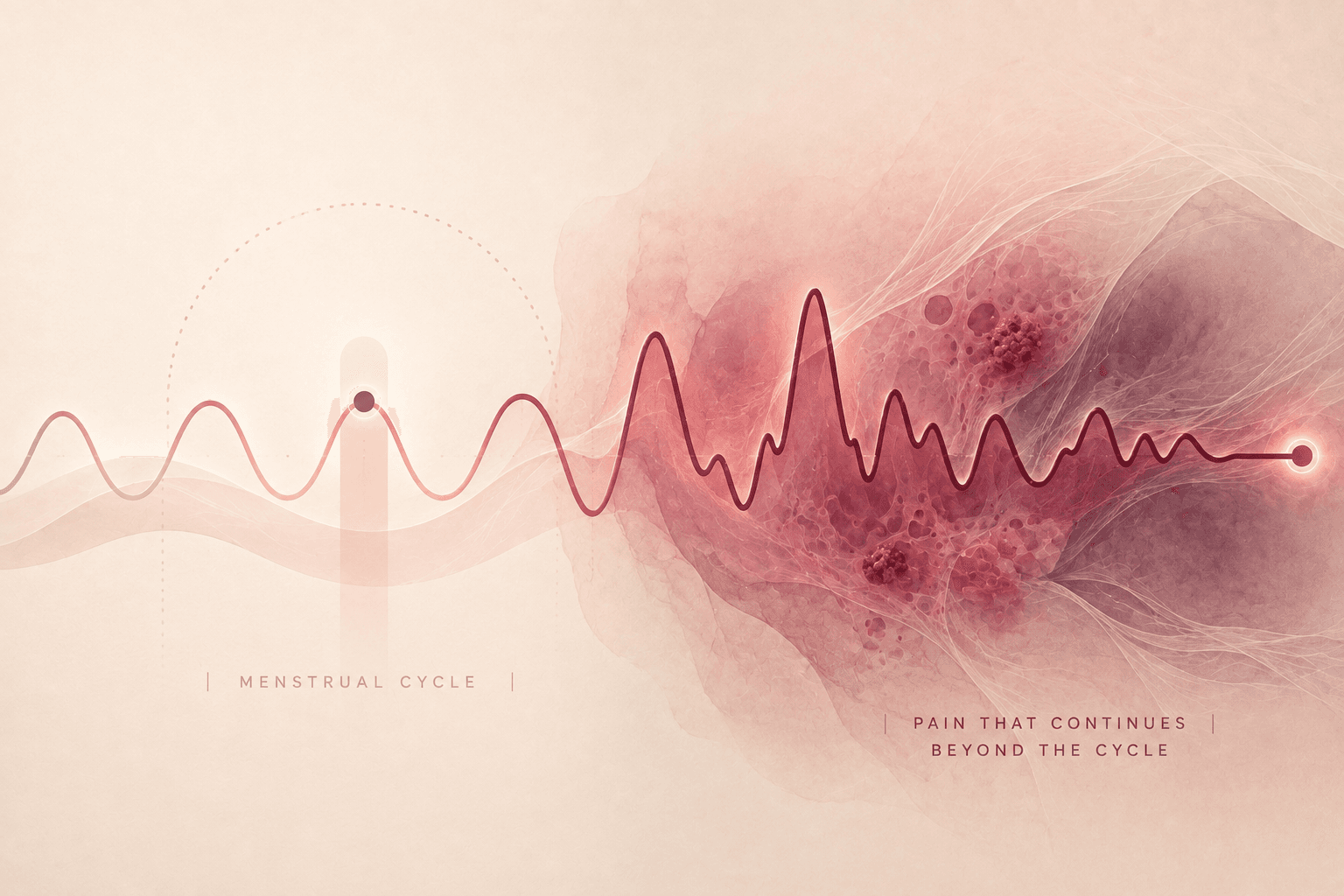
When period pain stops feeling like "just period pain"
Maybe your first instinct is a hot-water bag.
Then a painkiller.
Then another one.
You tell yourself it is probably just a painful period. Your mother had painful periods. Your friends do too. Maybe this is simply what menstruation feels like.
But what if your period pain makes you miss college?
What if you cannot sit through a workday?
What if bowel movements hurt during your period, sex becomes painful, or the pain continues after your bleeding stops?
And what if someone tells you: "Everyone gets period pain."
Some do. But pain that repeatedly takes you away from your normal life deserves to be heard.
One possible explanation is endometriosis — a chronic condition in which tissue resembling the lining of the uterus grows outside the uterus, commonly affecting the pelvis and causing inflammation, pain and scar tissue formation. [1] [2]
Quick answer
Endometriosis is a chronic inflammatory condition in which tissue resembling the lining of the uterus grows outside the uterus. It most commonly affects the pelvis and can cause inflammation, scar tissue and adhesions. [1] [2]
Symptoms can include:
- Severe or worsening period pain
- Chronic pelvic pain
- Pain during or after sex
- Pain with bowel movements or urination
- Heavy or irregular bleeding
- Bloating or nausea
- Fatigue
- Difficulty becoming pregnant
But endometriosis does not look the same in every woman. Some women have significant disease with relatively few symptoms, while others experience severe pain. Pain severity alone does not tell you how extensive the disease is. [2]
What exactly is endometriosis?
Your uterus normally has a lining that responds to hormonal changes during the menstrual cycle.
In endometriosis, endometrium-like tissue grows outside the uterus. It may occur around the ovaries, fallopian tubes and pelvic lining, and occasionally elsewhere in the body. [1]
This tissue can respond to hormonal changes, contributing to inflammation and, over time, scar tissue and adhesions. Those changes can affect nearby organs and contribute to pain. [1] [2]
Endometriosis is also not a condition that only begins in your thirties. Symptoms can start from the very first period and continue until menopause. [1] A teenager whose periods repeatedly keep her out of school deserves the same attention as an adult with the same symptoms.
And this is important: the amount of pain does not necessarily tell you the "stage" of endometriosis.
So the question is not simply "how bad is my pain?" It is: what pattern is happening, and what is it stopping me from doing?
What causes endometriosis?
No one fully knows why endometriosis develops in some women and not others — and that uncertainty is part of what makes it so hard to explain to a doctor, or to family who want a simple answer. Here's what research points to so far.
Genetics
Endometriosis can run in families. Having a mother or sister with the condition makes you somewhat more likely to develop it too. Family history is recognised as one factor associated with endometriosis. [1] [4]
Hormonal factors
Endometriosis is oestrogen-dependent — the same hormone that drives your monthly cycle can also fuel the growth and activity of this misplaced tissue. Hormonal treatments are therefore commonly used to reduce cycle-related symptoms. [2]
Immune factors
In some women, the immune system may not clear stray endometrial cells as efficiently, which may allow them to implant and grow outside the uterus. Emerging research also points towards immune-system dysregulation, although the exact mechanisms remain under investigation. [1]
Environment and lifestyle
Researchers are also studying whether environmental exposures and lifestyle factors play a role, though the evidence here is still developing.
No single cause explains every woman's experience. Not knowing exactly why it happened to you doesn't make your symptoms any less real.
How common is it?
The World Health Organization estimates that endometriosis affects around 10% of women of reproductive age worldwide — about 190 million people. [1]
India does not yet have one nationally representative prevalence estimate, and studies from different populations have produced different numbers. But Indian research is increasingly showing how significant the condition is, and how difficult diagnosis can be.
A 2025 Indian qualitative study interviewed 21 women with laparoscopically diagnosed endometriosis across two states. Common symptoms included painful periods, heavy menstrual bleeding, pain during sex, bowel and bladder symptoms and irregular bleeding. Among these women, the time between symptoms and diagnosis ranged from none at all to 21 years, averaging 6.3 years. Normalisation of pain, lack of awareness and dismissal of symptoms were among the barriers described. [3]
These numbers describe a small group of women interviewed in depth, not a national average. But the pattern they describe is consistent with what has been reported globally.
That makes one message particularly important: pain does not become normal simply because it happens every month.
What does endometriosis feel like?
There is no single "endometriosis pain."
For one woman it may feel like severe cramping. For another, it may feel stabbing, burning, deep or persistent.
You may notice:
Severe period pain
Pain that is getting worse or repeatedly stops normal activities deserves attention. Severe menstrual pain is one of the most important symptoms associated with endometriosis. [1] [2]
Pelvic pain outside your period
Endometriosis can cause pain that continues between periods. [1]
Pain during or after sex
Deep pelvic pain during or after intercourse can occur. [1]
Bowel symptoms
Painful bowel movements, constipation, diarrhoea or other bowel symptoms may worsen around menstruation. [1]
Urinary symptoms
Pain while urinating or pelvic discomfort around periods can occur. [1]
Heavy bleeding or spotting
Some women experience heavier periods or bleeding between periods. [1]
Fatigue
Chronic pain can be physically and emotionally exhausting. Endometriosis can have significant effects on quality of life and mental wellbeing. [1] [3]
Fertility difficulties
Some women first encounter endometriosis while being evaluated for difficulty conceiving. Endometriosis is recognised as one possible cause of female infertility. [1] [5]
You do not need to have all these symptoms.
The pattern matters more than one symptom
Imagine two women.
Woman A has mild cramps on the first day of her period. She takes a painkiller if needed and continues her day.
Woman B spends the first two days of every period in bed, misses work, has painful bowel movements and experiences pelvic pain between periods.
Both can say: "I get period pain."
But the patterns are completely different.
When speaking with your doctor, don't only say "my periods are painful." Tell them: this is what the pain stops me from doing.
That can be much more clinically useful. Endometriosis can have very different presentations, and the relationship between symptoms and disease extent is not always straightforward. [2]
Why can diagnosis take so long?
Endometriosis can resemble other conditions, including adenomyosis, fibroids, pelvic inflammatory disease and some bowel or urinary disorders. [2] [3]
There is also a social problem.
Women may be told: "Periods are painful for everyone." Or: "It will get better after marriage." Or: "Have a baby and it will go away."
These beliefs can delay appropriate care — and the last one is simply not true. Pregnancy is not a treatment for endometriosis. Some women find their symptoms quieten while they are pregnant or breastfeeding, because of the hormonal changes involved, but symptoms commonly return afterwards. Endometriosis is not a reason to rush into a pregnancy you are not ready for. [1] [2]
WHO notes that diagnostic delays remain common globally, while Indian research has documented how normalisation and dismissal of menstrual pain can contribute to delayed diagnosis. [1] [3]
You do not need to wait until your pain becomes unbearable to ask for help.
How is endometriosis diagnosed?
There is no single blood test that definitively diagnoses endometriosis.
Your doctor will first want to understand your symptoms and their pattern — this part is a conversation, not a test you can fail. [1] [2]
They may ask:
- When did the pain begin?
- Is it linked to your period?
- Does it occur between periods?
- Does it affect work, college or sleep?
- Is sex painful?
- Are bowel movements or urination painful?
- How heavy is your bleeding?
- Are you trying to conceive?
A pelvic examination may be appropriate depending on your symptoms.
What about ultrasound?
Ultrasound can identify or raise suspicion for some forms of endometriosis, including ovarian endometriomas and certain deep lesions. [1] [2] MRI may be useful in selected situations.
But: a normal scan does not automatically rule out endometriosis. [1] [2]
Modern guidance has also changed the role of diagnostic laparoscopy. Surgery is not necessarily required before treatment begins. Depending on symptoms and imaging, treatment may be started clinically; laparoscopy can still be considered when imaging is negative or treatment is unsuccessful or inappropriate. [1] [2]
So diagnosis is not about finding one magic test. It is about putting the symptoms, examination and investigations together.
How is endometriosis treated?
There is currently no treatment that guarantees a permanent cure, but symptoms can be managed and quality of life improved. [1]
Treatment depends on your symptoms, age, disease characteristics, previous treatment, preferences and reproductive plans. [2]
Pain medicines
NSAIDs and other pain-relieving medicines may help manage pain. [1] If you find yourself steadily increasing the dose, or taking painkillers for more days each cycle, that is a reason to see a doctor rather than to keep going. Regular high-dose use of anti-inflammatory painkillers carries its own risks to the stomach and kidneys, and needing more of them is itself useful clinical information.
Hormonal treatment
Hormonal medicines can reduce or suppress cycle-related activity and pain. Depending on the individual situation, options may include combined hormonal contraceptives, progestogens and GnRH-based treatments. [1] [2]
These are prescription medicines and are generally not suitable when you are actively trying to conceive. GnRH-based treatments in particular need specialist supervision, because lowering oestrogen over longer periods can affect bone density and often requires additional protective treatment. [2]
Surgery
Laparoscopic surgery may be considered for selected women, particularly when symptoms persist despite medical treatment, when certain lesions or endometriomas are present, or when fertility-related factors make surgery appropriate. [2]
Surgery can remove lesions, endometriomas or adhesions. But surgery is not automatically the answer for everyone. Repeated ovarian surgery also needs careful consideration because it can affect ovarian reserve. [2]
The decision should be individualised rather than based simply on the fact that endometriosis is present.
What about fertility?
This is often the question that causes the most fear: "Will I be able to have a baby?"
Endometriosis can affect fertility through inflammation, adhesions, changes around the ovaries and fallopian tubes, endometriomas and other mechanisms. [1] [2]
But: endometriosis does not equal infertility.
WHO notes that among women experiencing infertility, endometriosis may be present in 25–50%. This figure refers to women who are already experiencing infertility — not to the general population, and not to every woman with endometriosis. [1]
If you are not trying to conceive, controlling pain and symptoms may be the immediate priority.
If you want to become pregnant, your doctor may consider:
- Your age
- Ovarian reserve
- Location and extent of endometriosis
- Tubal status
- How long you have been trying
- Other fertility factors, including your partner's
Depending on the situation, management may include trying naturally, surgery in selected cases, IUI or IVF. [2] [5]
There is no single fertility pathway for every woman with endometriosis. ESHRE recommends individualised decisions based on factors including pain, age, ovarian reserve, previous surgery and other infertility factors. [2]
Should you freeze your eggs?
Not automatically.
Fertility preservation may be discussed in selected women, particularly when ovarian endometriomas, planned ovarian surgery or reduced ovarian reserve may affect future fertility. [2]
But an endometriosis diagnosis alone does not mean "freeze your eggs immediately." It is a personalised conversation involving your age, ovarian reserve, ovarian involvement, treatment plans and reproductive goals. [2]
What can you do day to day?
Lifestyle measures do not remove endometriosis, but they can support wellbeing and symptom management. [1]
You may find it useful to:
- Track pain alongside your cycle
- Record bowel and urinary symptoms
- Prioritise sleep
- Stay physically active within your tolerance
- Use heat if it helps
- Address constipation
- Eat a balanced diet
- Seek psychological support when chronic pain affects your mood
Pelvic-floor physiotherapy and psychological approaches such as CBT can also form part of multidisciplinary pain management for selected women. [1]
And please remember: needing pain treatment does not mean you are weak. Chronic pain is exhausting.
When should you see a doctor?
Consider an evaluation if:
- Period pain repeatedly stops normal activities
- Pain is getting worse
- Pain continues outside your period
- Sex is painful
- Bowel movements or urination hurt around your period
- You have persistent pelvic pain
- Bleeding is unusually heavy or prolonged
- You are having difficulty becoming pregnant
- Symptoms are affecting your emotional wellbeing or quality of life
Seek urgent medical care — the same day — if you develop sudden, severe pelvic or abdominal pain, particularly with fever, vomiting, fainting or heavy bleeding, or if there is any chance you could be pregnant. Sudden severe pain of this kind needs immediate assessment, because it can have causes that require emergency treatment.
These symptoms can occur with endometriosis, but they can also have other causes. A clinical evaluation can help distinguish between them. [1] [2]
You don't have to wait until you are unable to function.
Your endometriosis check-in
Before your appointment, write down:
- Pain. Where is it and how severe is it?
- Timing. Only during your period — or throughout the month?
- Function. What can you no longer do because of it?
- Bowel and bladder. Do these symptoms worsen around your period?
- Sex. Is intercourse painful?
- Bleeding. Are your periods unusually heavy or prolonged?
- Fertility. Are you trying to conceive?
That little list can turn "my periods are really painful" into a much more useful clinical conversation.
From the doctor's desk
"Severe period pain should never be dismissed simply because it happens every month. Endometriosis can present differently in every woman, so listening carefully to the timing, severity and associated symptoms is extremely important. Early recognition can help us choose appropriate treatment and protect both quality of life and reproductive goals."
— Dr. Sowmya Sampurna M, Consultant Obstetrics & Gynaecology
Key takeaways
- Endometriosis occurs when endometrium-like tissue grows outside the uterus. [1]
- The exact cause is unknown, but genetics, hormonal and immune factors appear to contribute. [1] [2]
- Symptoms can begin from the first period, not only in adulthood. [1]
- Severe period pain is an important symptom, but pelvic, bowel, urinary and sexual pain can also occur. [1]
- Heavy bleeding, fatigue and fertility difficulties are possible. [1]
- A normal ultrasound does not necessarily rule out endometriosis. [1] [2]
- Surgery is not automatically required for diagnosis or treatment. [1] [2]
- Pregnancy is not a cure for endometriosis. [1] [2]
- Treatment depends on symptoms, disease characteristics and reproductive goals. [2]
- Endometriosis can affect fertility but does not equal infertility. [1]
- Earlier recognition can reduce years of unnecessary suffering. [1] [3]
References
[1] World Health Organization. Endometriosis. Fact sheet, 15 October 2025.
[2] Becker CM, Bokor A, Heikinheimo O, et al.; ESHRE Endometriosis Guideline Group. ESHRE guideline: endometriosis. Human Reproduction Open. 2022;2022(2):hoac009. doi:10.1093/hropen/hoac009
[3] Rajbangshi PR, Desai S, Gajbhiye RK, Zondervan KT, Jain V, Norton R. Experiences of women with endometriosis & their partners in India: findings from a qualitative study. Indian Journal of Medical Research. 2025;162(5):622–630. doi:10.25259/IJMR_1338_2025
[4] Varghese N, Shanmugam I, Sivamani H, Durairaj A. Prevalence and risk factors of endometriosis among infertile women in a tertiary care center in South India. Cureus. 2024;16(10):e71772. doi:10.7759/cureus.71772
[5] World Health Organization. Infertility. Fact sheet, 28 November 2025.