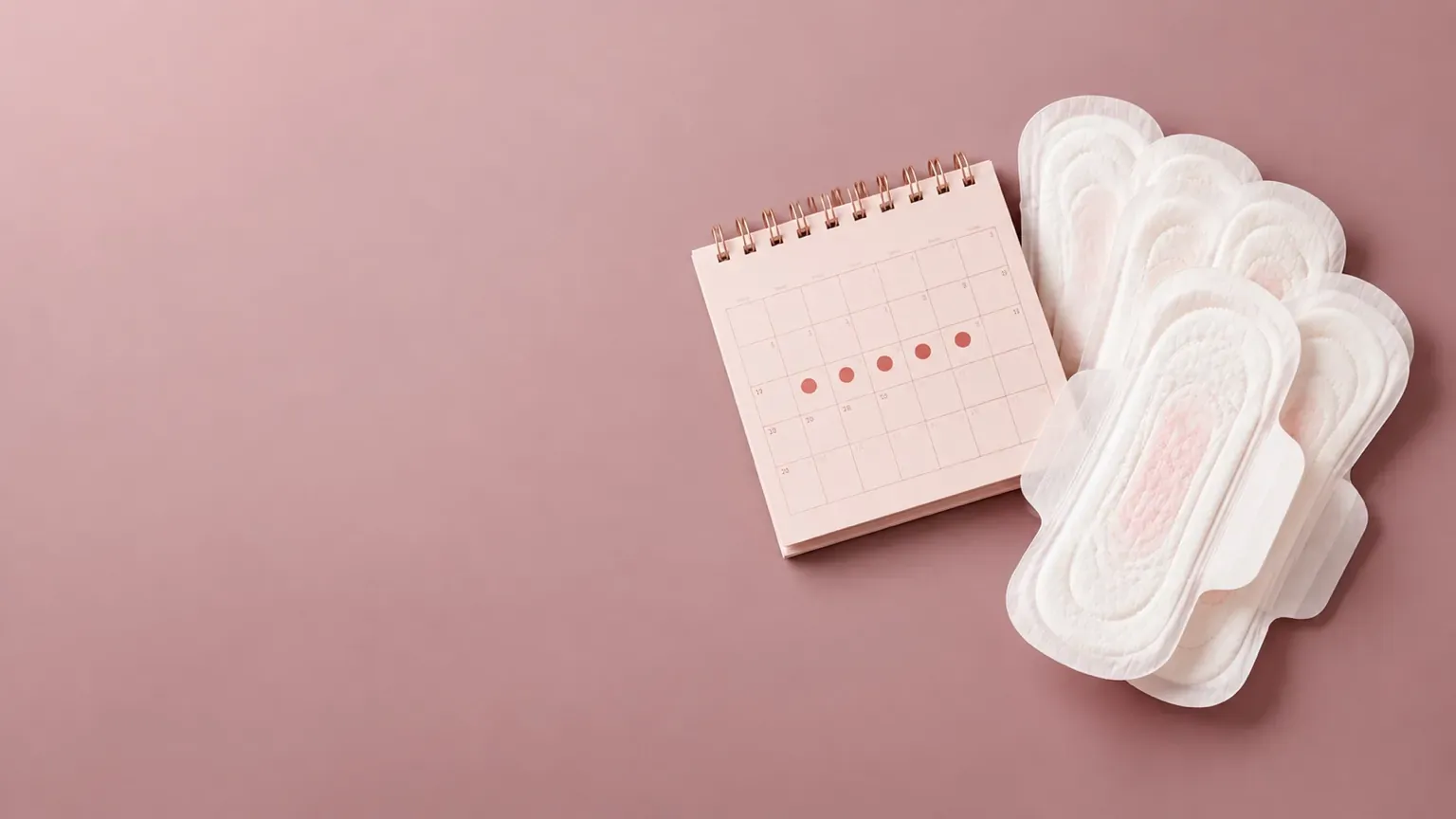
A teenager may quietly carry extra pads to school, worry about staining her uniform, or feel exhausted every month — and still wonder whether what she is experiencing is simply what a “normal period” feels like.
Heavy periods can happen during the first few years after menarche because ovulation is still becoming established. But very heavy or disruptive bleeding deserves attention, particularly if it has been present from the very first periods.1
The important question isn’t simply, “Are her periods heavy?”
It is: “Are they heavy enough to affect her health or everyday life?”
What counts as a heavy period?
There is no need to measure menstrual blood loss at home.
Look for practical signs such as:
- Bleeding for more than 7 days
- Soaking through a pad or tampon every 1–2 hours, particularly on the heaviest days
- Bleeding through clothes or bedsheets
- Needing to change menstrual products during the night
- Passing unusually large clots
- Missing school, sports or normal activities because of bleeding 1 2
If this happens repeatedly, it is worth discussing with a doctor.
Isn’t heavy bleeding common in teenagers?
It can be.
During the first few years after menarche, the hormonal system that controls ovulation is still maturing. Cycles without ovulation can lead to heavier or irregular bleeding. Thyroid disorders and PCOS/PMOS can also contribute. 1 3
But there is another possibility that shouldn’t be overlooked: a bleeding disorder.
In adolescents presenting for evaluation of heavy menstrual bleeding, ACOG reports that bleeding disorders are found in approximately 20%, rising to about 33% among those hospitalised for heavy menstrual bleeding. These are selected groups seeking medical care — they do not mean that one in five teenagers generally has a bleeding disorder. 1
Could it be a bleeding disorder?
Yes, particularly when heavy bleeding is accompanied by other clues.
Von Willebrand disease (VWD) is the most common inherited bleeding disorder**.** Other possibilities include platelet-function disorders and clotting-factor deficiencies. 1 4
Ask your teenager — gently, without making her feel frightened:
“Do you also notice any of these?”
- Frequent or difficult-to-stop nosebleeds
- Bruising easily or without an obvious reason
- Cuts that seem to bleed for unusually long
- Excessive bleeding after dental treatment or surgery
- A family history of a diagnosed bleeding disorder
- Anaemia that keeps returning despite treatment 1 4
Heavy periods beginning with menarche can be an important clue. In one cohort of women with type 1 VWD, heavy menstrual bleeding at menarche was the first bleeding symptom in 53%. 4
But one symptom alone does not diagnose VWD.
What about anaemia?
This is one of the biggest reasons heavy periods should not simply be tolerated.
Repeated blood loss can gradually deplete iron stores and eventually cause iron-deficiency anaemia. A teenager may notice:
- Tiredness
- Weakness
- Headaches
- Poor concentration
- Breathlessness with activity
- Pale skin
Even low iron stores without anaemia can be associated with fatigue and difficulties with cognition. 1
And this has particular relevance in India. An Indian study of 655 adolescent girls attending a tertiary-care gynaecology service found that menstrual complaints were the commonest reason for consultation. Seventeen girls required hospitalisation for severe anaemia associated with puberty-related heavy bleeding, and all required blood transfusion. 5
This was a hospital-based study, so it cannot represent all Indian teenagers. But it illustrates why severe menstrual bleeding should not be dismissed.
A simple check-in
If you’re a teenager, or you’re a parent wondering whether your daughter’s periods need attention, ask:
- How long does the bleeding last?
- How often do you need to change a pad?
- Are you leaking through clothes or bedsheets?
- Do you feel unusually tired or breathless during your period?
- Do you bruise or bleed easily elsewhere?
- Does anyone in the family have unusually heavy periods or a diagnosed bleeding disorder?
Writing these details down for two or three cycles can make a doctor’s consultation much more useful.
What will the doctor check?
The evaluation usually begins with a detailed menstrual and bleeding history, followed by an examination when appropriate.
Depending on the situation, the doctor may check for:
- Anaemia and iron deficiency, including a blood count and ferritin
- Hormonal or endocrine causes of abnormal bleeding
- Possible bleeding disorders
- Other medical causes suggested by the history 1
If a bleeding disorder is suspected, a haematologist may be involved. Testing for VWD can sometimes require careful interpretation because levels of von Willebrand factor can vary, and diagnosis is not always established by a single test. 1 4
When should you see a doctor?
Arrange an evaluation if periods repeatedly:
- Last longer than 7 days
- Require pad changes every 1–2 hours
- Cause flooding or significant leakage
- Interfere with school or everyday activities
- Leave her very tired, pale or breathless
- If she is soaking through a pad or tampon every hour for several hours in a row, especially if she is dizzy, faint, very weak or short of breath, seek urgent medical care. 1 2
Seek urgent medical care if bleeding is extremely heavy and she becomes faint, dizzy, very weak, short of breath, confused or otherwise appears unwell.
And please don’t make her feel embarrassed about discussing it.
Periods are a health issue — not something she needs to hide.
Key Takeaways
- Heavy periods in teenagers are not always caused by a bleeding disorder.
- Hormonal immaturity and anovulatory cycles are common causes during adolescence. 1 3
- Heavy bleeding from the first period, easy bruising, frequent nosebleeds or a family history of abnormal bleeding should raise suspicion for a bleeding disorder. 1 4
- Repeated heavy bleeding can cause iron deficiency and anaemia.
- A teenager should not have to miss school, sports or normal life every month because of her period.
- Getting evaluated does not mean something serious is definitely wrong. It simply helps find the reason — and appropriate treatment.
References
[1] American College of Obstetricians and Gynecologists. Screening and Management of Bleeding Disorders in Adolescents With Heavy Menstrual Bleeding. Committee Opinion No. 785. Obstetrics & Gynecology. 2019.https://www.acog.org/clinical/clinical-guidance/committee-opinion/articles/2019/09/screening-and-management-of-bleeding-disorders-in-adolescents-with-heavy-menstrual-bleeding
[2] Centers for Disease Control and Prevention. About Heavy Menstrual Bleeding. 2024.https://www.cdc.gov/female-blood-disorders/about/heavy-menstrual-bleeding.html
[3] American College of Obstetricians and Gynecologists. Menstruation in Girls and Adolescents: Using the Menstrual Cycle as a Vital Sign.https://www.acog.org/clinical/clinical-guidance/committee-opinion/articles/2015/12/menstruation-in-girls-and-adolescents-using-the-menstrual-cycle-as-a-vital-sign
[4] American Society of Hematology, International Society on Thrombosis and Haemostasis, National Hemophilia Foundation & World Federation of Hemophilia. Clinical Practice Guidelines on von Willebrand Disease.2021.https://www.hematology.org/education/clinicians/guidelines-and-quality-care/clinical-practice-guidelines/von-willebrand-disease
[5] Rathod AD, Chavan RP, Pajai SP, et al. Gynecological Problems of Adolescent Girls Attending Outpatient Department at Tertiary Care Center with Evaluation of Cases of Puberty Menorrhagia Requiring Hospitalization. Journal of Clinical and Diagnostic Research. 2016.https://pubmed.ncbi.nlm.nih.gov/27651637/