Estimated Reading Time: 9–10 minutes
Article Category: Pillar | Women’s Health | Hormonal & Metabolic Health
Last Reviewed: August 2026
Last Updated: August 2026
Researched and Written by:
Madhu Varshini MS, Founder, Saisha Health
Medically Reviewed by:
Dr. Sowmya Sampurna M
MBBS, MD (OBG), FMAS, FRM
Consultant Obstetrician & Gynaecologist
High-Risk Pregnancy • Laparoscopic & Robotic Surgeon • Infertility Specialist
Maybe You’ve Heard of PCOS(PMOS). But What Does It Actually Mean?
Maybe your periods have never been particularly predictable. Perhaps you have struggled with acne long after your teenage years. Maybe you have noticed more facial hair, thinning scalp hair or changes in your weight. Or perhaps you are trying to become pregnant and someone has mentioned PCOS.
Then come the questions:
- Do I really have cysts?
- Will I be able to have children?
- Is this because I gained weight?
- Will I get diabetes?
Let’s slow this down.
PCOS — now referred to as Polyendocrine Metabolic Ovarian Syndrome (PMOS) in newer international terminology — is a complex hormonal and metabolic condition. It can affect periods, ovulation, skin, hair, metabolism, fertility and emotional wellbeing. Having PCOS(PMOS) does not mean your body is broken, that you are infertile or that you have done something wrong. 7
What Is PCOS — and Why is it now called PMOS?
For decades, the condition has been known as polycystic ovary syndrome, or PCOS. The newer terminology, PMOS, is intended to reflect that the condition involves much more than the ovaries. PCOS will continue to appear in medical literature and clinical settings during the terminology transition. 2 7
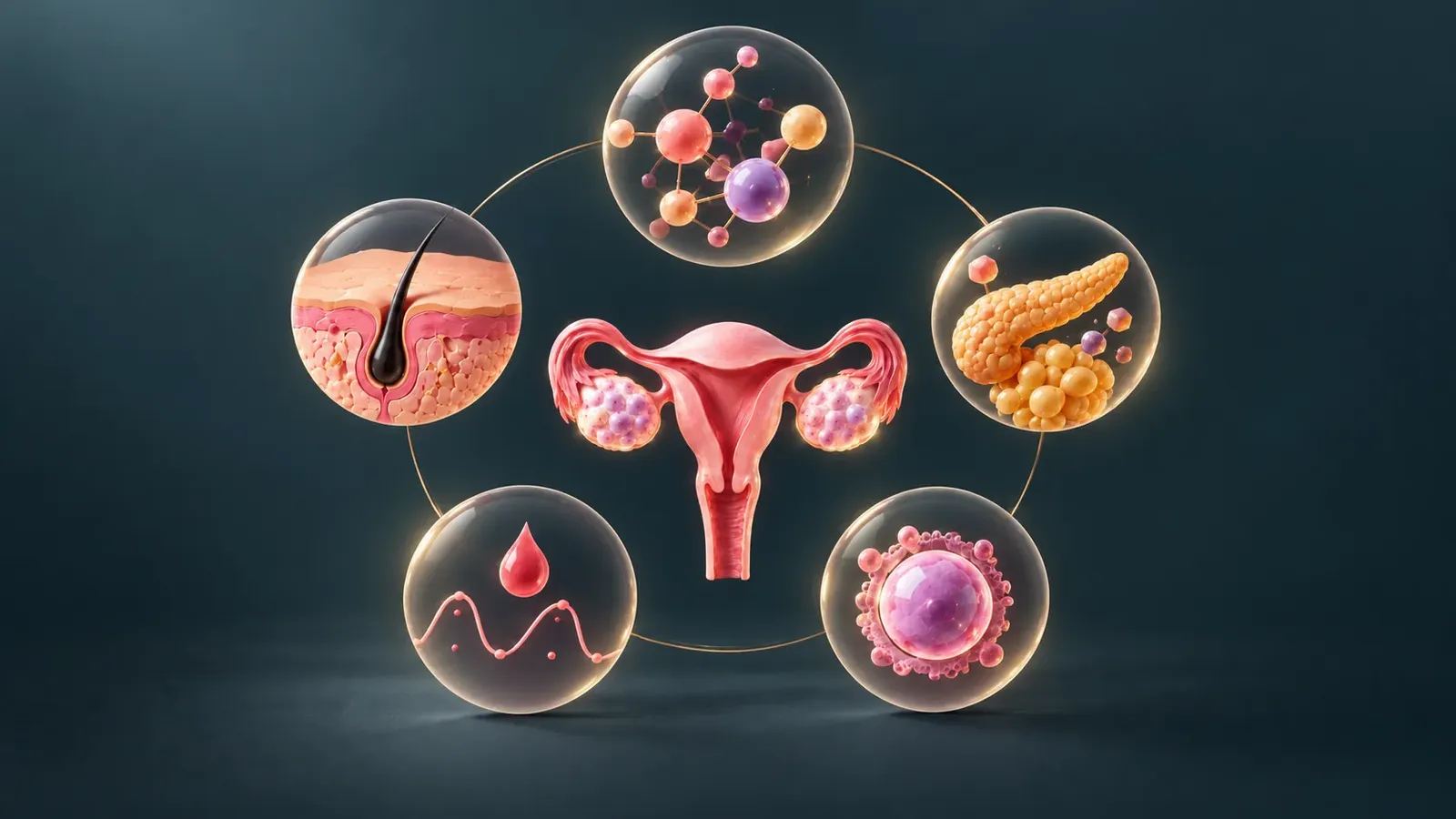
Think of it as several connected systems:
Hormones ↔ ovaries ↔ ovulation ↔ metabolism ↔ skin/hair ↔ fertility ↔ long-term health
That is why calling it simply an “ovarian problem” does not tell the whole story.
What Does PCOS(PMOS) Look Like in India?
Indian research is useful because prevalence estimates can look very different depending on how PCOS is defined and which population is studied. A large nationwide Indian study published in JAMA Network Open in 2024 included 9,824 women aged 18–40 from five regions of India. Depending on the diagnostic criteria used, estimated prevalence ranged from 7.2% using NIH criteria to 19.6% using Rotterdam criteria. 3
So which number should you remember? Not one particular number. Remember that PCOS is common in India, but prevalence estimates depend partly on how the condition is defined and measured. 3 That is also why an online symptom checklist cannot diagnose you.
So, What Actually Happens in PCOS(PMOS)?
Think of your menstrual cycle as a conversation.
- Your brain sends hormonal signals.
- Your ovaries respond.
- An egg develops.
- Ovulation occurs.
- Hormones change.
- Your uterine lining responds.
In PCOS, this communication can become less predictable. Higher androgen activity can contribute to acne, increased facial or body hair and scalp hair thinning. Irregular ovulation can lead to irregular or absent periods. Metabolic changes, including insulin resistance, can also occur. But PCOS is not simply an insulin problem. Genetic, hormonal and metabolic factors interact. 1
What Are the Symptoms?
There is no single symptom that gives you the answer.
You may experience:
- Irregular periods
You may have long gaps between periods, fewer periods or periods stopping for months. 1 - Acne and oily skin
Higher androgen activity can increase oil production and contribute to acne. But acne alone does not diagnose PCOS. 1 - Increased facial or body hair
New or progressively coarse hair, particularly around the upper lip, chin, chest or abdomen, may indicate increased androgen activity. This is called hirsutism. And please remember: facial hair is a biological symptom — not a failure of personal grooming. - Hair thinning
Some women experience thinning around the crown or central parting. - Changes in weight or metabolism
Some women with PCOS experience weight gain or metabolic abnormalities. Others don’t.
You can have PCOS(PMOS) at any body size. A woman who is lean can still have PCOS(PMOS), insulin resistance or metabolic risk, while having obesity does not automatically mean you have PCOS. 1
PCOS(PMOS) Is Not a Weight Problem
Let’s address something many Indian women hear:
“Just lose weight and your PCOS will go away.”
It isn’t that simple. PCOS can occur across the weight spectrum. Weight can be relevant to metabolic health, and for some women, weight management may improve health outcomes. But healthy lifestyle behaviours can improve health even without weight loss. 1
Perhaps the goal should not be: “Make your body smaller.” It should be: “Make your health stronger.”
How Is PCOS Diagnosed?
There is no single “PCOS blood test.”
In adults, diagnosis considers three broad features: 1 2
- Ovulatory dysfunction
Usually reflected by irregular or infrequent menstrual cycles. - Hyperandrogenism
This may be clinical, such as hirsutism, or biochemical, shown through appropriate blood testing. - Polycystic ovarian morphology
An ultrasound may show a particular ovarian follicle pattern. In adults, appropriately interpreted AMH may also be used as an alternative to ultrasound within the diagnostic pathway. 1
Generally, two relevant features may support diagnosis after other causes have been excluded. 1
And here is an important myth: You do not need ovarian “cysts” to have PCOS. The follicles seen on ultrasound are not necessarily the ovarian cysts people imagine when they hear the word cyst. Seeing multiple follicles does not automatically mean you have PCOS. 1
What About Teenagers?
This needs extra care because puberty can resemble PCOS. Periods may naturally be irregular during the early years after menarche.
Certain patterns become more concerning later, such as:
- Cycles longer than 45 days between one and less than three years after menarche
- More than 90 days without a period after the first post-menarche year
Adolescent PCOS diagnosis requires both ovulatory dysfunction and hyperandrogenism. Ultrasound and AMH are not recommended as diagnostic tools in adolescents because of limited specificity at this stage. 6
So if your 14-year-old daughter’s periods are irregular, do not immediately assume: “She has PCOS.”Sometimes monitoring and reassessment is the right approach. 6
Why Does PCOS(PMOS) Happen?
The honest answer is that there is no single cause. Genetic factors appear to contribute, and PCOS can run in families. Hormonal and metabolic factors interact with genetic susceptibility. 1
But one food, one habit or one lifestyle choice does not cause PCOS. So please do not blame yourself. And parents, please do not blame your daughter.
The Metabolic Side of PCOS
This is easy to miss when conversations focus only on periods and fertility.
PCOS is associated with a higher risk of:
- Insulin resistance
- Impaired glucose regulation
- Type 2 diabetes
- Abnormal cholesterol
- High blood pressure
- Cardiometabolic disease
- Sleep apnoea in some women 1 4
The international guideline recommends assessing glucose status at diagnosis and monitoring metabolic risk, including lipids and blood pressure. The 75-g oral glucose tolerance test is identified as the most accurate glucose assessment in PCOS, regardless of BMI. 5
This does not mean: “If you have PCOS(PMOS), you will get diabetes.” It means knowing your risk gives you an opportunity to act early. Indian research also highlights why metabolic health matters. In the large Indian study mentioned earlier, women with PCOS had substantial rates of dyslipidaemia, obesity, fatty liver disease and metabolic syndrome. These figures describe that study population — not every woman with PCOS. 3
What Can You Do?
You do not need to redesign your life tomorrow morning. There is no single “PCOS diet” or universally superior exercise programme. 1
Instead, build sustainable habits around the food and lifestyle you already have. Think adequate nutrition, protein, fibre and overall balance rather than a magical PCOS food. Movement counts too. Choose something you can actually live with. You do not need to punish your body to care for it.
What About Treatment?
Treatment depends on what you need help with. Someone trying to regulate periods may need a different approach from someone trying to conceive. Acne, excess hair and metabolic risk may require different strategies. 1 5 So when someone says: “Take this exact supplement and your hormones will be fixed.” Pause. Popular is not the same as proven.
What If You Want to Have a Baby?
This is often the biggest fear. “Will I be able to get pregnant?” For many women, yes. PCOS can make conception more difficult because ovulation may not happen regularly. But: PCOS does not equal infertility. 4 If you are planning pregnancy, metabolic health matters too because PCOS is associated with increased risks such as gestational diabetes and hypertensive disorders during pregnancy. 1
What PCOS Is NOT
Let’s clear up the big ones.
- PCOS does not mean you have ovarian cysts.
- PCOS does not mean infertility.
- PCOS only happens with obesity.
- You caused PCOS by eating “bad” food.
- You need a restrictive PCOS diet.
- PCOS means you will definitely develop diabetes.
PCOS(PMOS) is a complex, long-term condition that can look different at different body sizes and life stages. 1
When Should You See a Doctor?
Consider an evaluation if you have:
- Persistently irregular or absent periods
- New or significant facial or body hair growth
- Persistent acne alongside menstrual or androgen-related symptoms
- Unexplained scalp hair thinning
- Difficulty conceiving
- Significant metabolic risk factors or symptoms suggesting diabetes
- Persistent snoring or unrefreshing sleep
- Anxiety, depression or significant body-image distress 1
You do not need every symptom. And you do not need to diagnose yourself before asking for help. The purpose of an evaluation is to understand what is happening, not to put a frightening label on you.
Key Takeaways
- PCOS(PMOS) is a complex hormonal and metabolic condition affecting more than the ovaries.
- Irregular periods or acne alone do not diagnose PCOS.
- You do not need ovarian cysts to have PCOS.
- PCOS can occur at any body size.
- Teenagers require special consideration because normal puberty can resemble PCOS.
- Metabolic health deserves attention even when weight is not a concern.
- There is no single “PCOS diet.”
- Treatment depends on symptoms, risks and goals.
- PCOS can make conception more difficult, but it does not mean infertility.
- PCOS is a health condition, not a verdict on your body or your future.
References
[1] Teede HJ, Tay CT, Laven JJE, et al. Recommendations from the 2023 International Evidence-based Guideline for the Assessment and Management of Polycystic Ovary Syndrome. Human Reproduction. 2023;38(9):1655–1679. doi:10.1093/humrep/dead156. Original source
[2] International PCOS Network. International Evidence-based Guideline for the Assessment and Management of Polycystic Ovary Syndrome 2023. Monash University; 2023. Original guideline
[3] Ganie MA, Chowdhury S, Malhotra N, et al. Prevalence, Phenotypes, and Comorbidities of Polycystic Ovary Syndrome Among Indian Women. JAMA Network Open. 2024;7(10):e2440583. doi:10.1001/jamanetworkopen.2024.40583. Original source
[4] World Health Organization (WHO). Polycystic ovary syndrome. Updated January 22, 2026. Original source
[5] Teede HJ, Tay CT, Laven JJE, et al. 2023 International Evidence-based Guideline — diagnostic criteria, metabolic risk, lifestyle, psychological wellbeing and fertility management. Monash Centre for Health Research and Implementation. Guideline and clinical resources
[6] International PCOS Guideline — Adolescent Recommendations. 2023 International Evidence-based Guideline for the Assessment and Management of PCOS: adolescent diagnostic criteria, including the use of menstrual irregularity and hyperandrogenism and the avoidance of ultrasound/AMH for diagnosis in adolescents. Adolescent recommendations
[7] Monash Centre for Health Research and Implementation. PCOS Guideline / PMOS Guideline. Updated 2026. Current PMOS guideline and resources