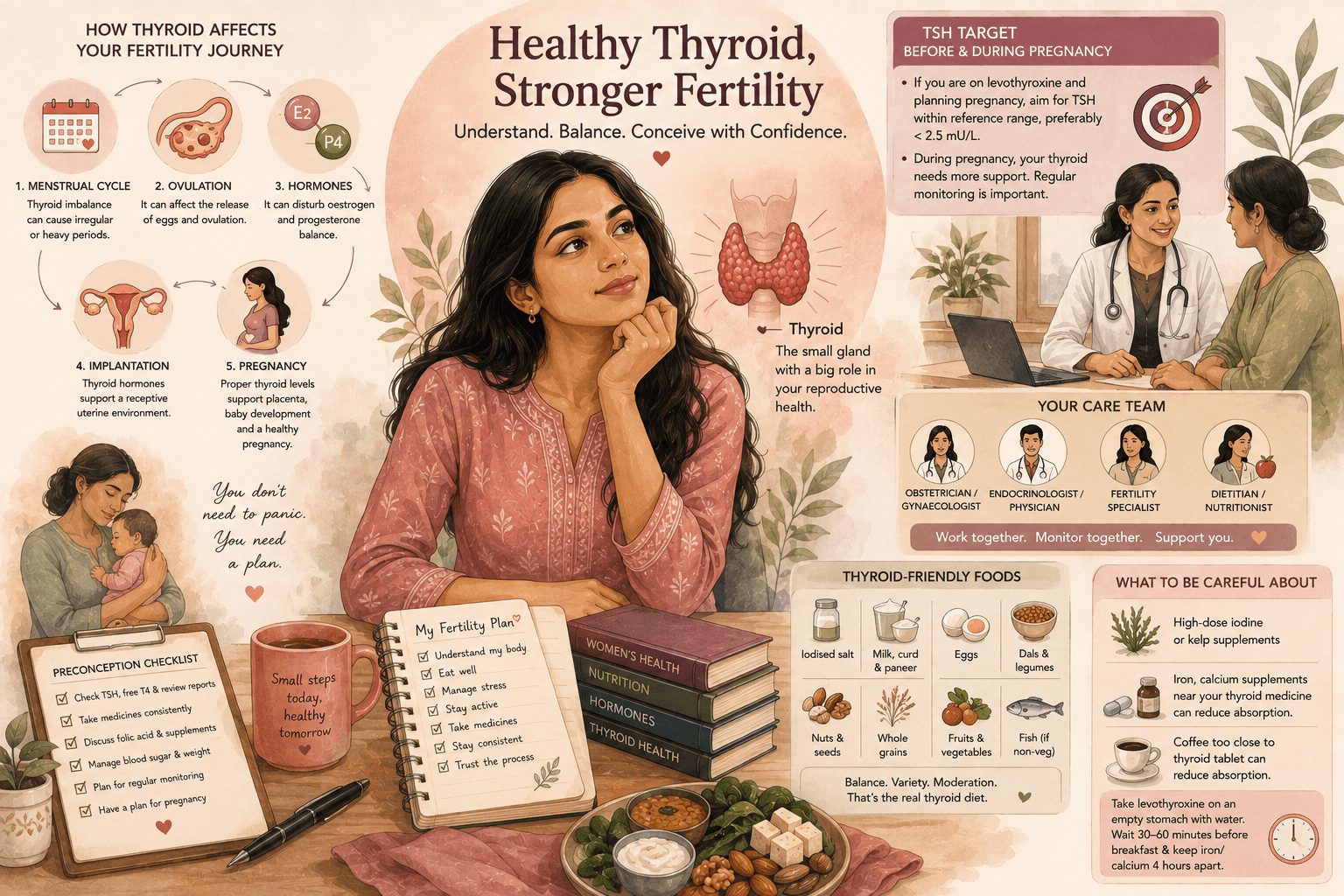
If you have ever looked at a thyroid report and worried about one number — TSH — you are not alone.
Perhaps your TSH was slightly high. Perhaps your periods became irregular. Perhaps you have PCOS, insulin resistance or difficulty conceiving.
Or perhaps someone told you:
“Your thyroid has to be perfectly normal before you can get pregnant.”
Let’s slow that conversation down.
Because the thyroid does matter for fertility. But having thyroid disease does not mean that pregnancy is out of reach.
This is especially relevant in India. A 2026 ICMR-linked systematic review of 60 Indian studies found a pooled prevalence of hypothyroidism of 17% among pregnant women, including 15% subclinical and 3% overt hypothyroidism. The researchers also noted substantial variation between studies, so this should not be interpreted as a precise prevalence for every Indian woman. [1]
The message isn’t “thyroid disease is everywhere, so be afraid.”
It is:
Thyroid health is common enough that women planning pregnancy should understand it.
First, what does TSH actually mean?
Think of TSH (thyroid-stimulating hormone) as the message your pituitary gland sends to the thyroid:
“We need more thyroid hormone.”
When thyroid hormone levels are low, TSH generally rises to encourage the thyroid to work harder.
But TSH is not the thyroid hormone itself, and one abnormal result does not tell the whole story.
Your doctor may also consider free T4, symptoms, thyroid antibodies, previous thyroid history, medications, pregnancy status and the laboratory’s reference range.
And pregnancy changes thyroid physiology, which is why pregnancy-specific interpretation matters. [2]
A mildly abnormal TSH is not automatically a fertility diagnosis.
The 2026 American Thyroid Association (ATA) guideline recommends confirming newly diagnosed subclinical hypothyroidism in many women by repeating TSH and free T4 after 4–6 weeks. Mild abnormalities can sometimes resolve. [2]
So don’t let one report become your fertility verdict.
Can thyroid problems affect fertility?
Yes — particularly when thyroid dysfunction is significant or untreated.
Thyroid hormones interact with the reproductive system at several levels, including the hypothalamic-pituitary-ovarian axis, prolactin, sex-hormone metabolism and ovarian function. Thyroid dysfunction can therefore contribute to menstrual disturbances, ovulatory problems and reduced fertility in some women. [3]
But two statements can be true at the same time:
Thyroid dysfunction can affect fertility.
A slightly high TSH does not automatically mean you cannot conceive.
That’s an important distinction.
The 2026 ATA guideline also notes that undiagnosed overt hypothyroidism is uncommon among women presenting with infertility, while milder thyroid abnormalities are more frequently encountered. [2]
So if conception is taking longer than expected, thyroid function is one piece of the puzzle, not necessarily the whole puzzle.
The thyroid–period connection
Sometimes the first clue isn’t infertility.
It is your period.
Thyroid dysfunction can alter menstrual patterns.
With hypothyroidism, some women experience:
- Longer or irregular cycles
- Infrequent periods
- Heavier bleeding
- Changes in bleeding duration
- Problems with ovulation
Hyperthyroidism can also disturb cycles, sometimes causing lighter or less frequent periods.
The relationship isn’t identical in every woman, and menstrual changes have many possible causes. But thyroid disease is one of the conditions doctors consider when a previously predictable cycle changes. [3]
So if your cycles suddenly move from 28–30 days to 45–60 days, don’t automatically label it as stress, PCOS or “just hormones.”
Sometimes the thyroid deserves a seat at the table.
How does thyroid function interact with reproductive hormones?
Your thyroid hormones and reproductive hormones don’t operate in separate rooms.
Thyroid dysfunction can influence pathways involving GnRH, FSH, LH, prolactin, sex-hormone binding globulin and ovarian function. In hypothyroidism, changes in hypothalamic signalling can increase prolactin, which may interfere with the hormonal signalling required for normal ovulation. [3][4]
This does not mean:
High TSH = low progesterone.
Human reproductive endocrinology is far more complicated.
Think of the thyroid as one section of an orchestra.
If that section falls out of rhythm, the music can change.
But the thyroid isn’t playing every instrument.
That is why correcting genuine thyroid dysfunction can help restore more regular reproductive function in women whose thyroid disease is contributing to their cycle or ovulation problems. [3][4]
What about ovulation?
Ovulation requires coordinated communication between the brain, pituitary gland and ovaries.
Significant hypothyroidism can interfere with this communication and, in more severe cases, ovulation may become irregular or stop. [3]
But mild thyroid abnormalities do not automatically mean that you aren’t ovulating.
If your periods are irregular, your doctor may need to consider several possibilities:
Thyroid function + PCOS/PMOS + prolactin + ovarian factors + metabolic health + weight + age + other reproductive factors.
This is why a thyroid test should not become an explanation for every fertility problem.
Can TSH affect conception?
It can — but the number needs context.
For women with established hypothyroidism who are taking levothyroxine and planning pregnancy, the 2026 ATA guideline considers a preconception TSH within the reference range but below 2.5 mU/L a logical treatment target. This provides some margin before pregnancy increases thyroid hormone requirements. [2]
But please don’t translate that into:
“My TSH is 2.6, so I cannot get pregnant.”
That is not what the guideline says.
For women whose TSH is within the normal range, small differences within that range do not automatically represent a fertility problem. [2]
For newly diagnosed subclinical hypothyroidism, the 2026 guideline recommends a more nuanced approach: repeat testing may be appropriate, and TSH above 10 mU/L should be treated with levothyroxine. For persistent milder abnormalities, treatment decisions depend on the clinical situation, timing and fertility plans. [2]
One number should prompt a conversation, not a catastrophe.
What about implantation?
This is where we need to be careful.
Implantation depends on the embryo, endometrium, ovarian hormones, uterine environment and many other biological factors.
Thyroid dysfunction — particularly overt hypothyroidism — is associated with poorer reproductive and pregnancy outcomes, and thyroid dysfunction may influence processes involved in follicular development, fertilisation and implantation. [3]
But that does not mean:
“A mildly elevated TSH prevents implantation.”
The evidence around mild or subclinical abnormalities is considerably more nuanced.
So if you’ve had one unsuccessful embryo transfer or one early pregnancy loss and your TSH happened to be slightly elevated, don’t immediately conclude:
“My thyroid caused it.”
There may be several contributing factors — and sometimes no single cause can be identified.
And what about staying pregnant?
This is where treating established thyroid disease becomes particularly important.
Untreated or inadequately treated overt hypothyroidism during pregnancy is associated with adverse maternal and pregnancy outcomes, including miscarriage and hypertensive and preterm complications. [1][2]
But here’s the reassuring part:
Appropriately treated hypothyroidism is compatible with a healthy pregnancy.
The 2026 ATA guideline notes that women with hypothyroidism who achieve biochemical control with levothyroxine can have pregnancy and child outcomes similar to those without hypothyroidism. [2]
So:
Thyroid disease is something to manage — not something to fear.
Why pregnancy changes the thyroid game
Pregnancy increases the body’s thyroid hormone demands.
Changes occur in:
- Thyroid hormone production
- Thyroxine-binding proteins
- Iodine handling
- Placental thyroid physiology
- hCG, which can influence thyroid function
A woman whose thyroid was coping comfortably before pregnancy may therefore need closer monitoring or a medication adjustment once pregnant. [2][5]
This is why thyroid care ideally begins before the positive pregnancy test, not after it.
If you’re taking levothyroxine, don’t stop it
If you take levothyroxine for hypothyroidism, pregnancy is not a reason to stop it.
Levothyroxine is the standard thyroid hormone replacement used during pregnancy. Women already taking it may require a higher dose during pregnancy because thyroid hormone requirements increase. [2][6]
If you are planning pregnancy, have your thyroid function reviewed beforehand.
And once you get a positive pregnancy test, contact your thyroid care team promptly rather than waiting for the next routine appointment. [2]
The important thing is not merely taking the tablet.
It is taking the right dose consistently and monitoring whether that dose remains appropriate.
What about TPO antibodies?
TPO antibodies can make thyroid care sound much more frightening than it needs to be.
A woman can be TPO-antibody positive while having normal thyroid function.
That does not automatically mean she has hypothyroidism.
The 2026 ATA guideline specifically says that euthyroid women with TPO antibodies should not automatically be given levothyroxine simply because the antibodies are positive. Instead, thyroid function can be monitored because pregnancy can increase the likelihood of developing thyroid dysfunction. [2]
This is a major shift away from treating every laboratory finding as a disease.
An antibody result is a risk marker — not necessarily a treatment indication.
Your thyroid care team
You don’t necessarily need a room full of specialists.
But you do need coordinated care.
Depending on your situation, your team may include:
Obstetrician/gynaecologist
For periods, ovulation, fertility and pregnancy.
Endocrinologist or physician
For thyroid diagnosis, medication and metabolic health.
Fertility specialist
If conception is taking longer than expected or assisted reproduction is being considered.
Dietitian/nutritionist
When nutrition needs attention or you are tempted by restrictive “thyroid diets.”
The most important thing is that everyone knows what the others are doing.
How often should thyroid be monitored?
There is no universal schedule for every woman.
Monitoring depends on whether you:
- Already have hypothyroidism
- Take levothyroxine
- Have recently changed your dose
- Are TPO-antibody positive
- Are undergoing fertility treatment
- Are pregnant
- Have Graves’ disease or another thyroid disorder
For euthyroid TPO-antibody-positive women planning pregnancy, the 2026 ATA guideline suggests thyroid-function monitoring every 3–6 months. Once pregnant, monitoring becomes more frequent, particularly during the first half of pregnancy. [2][5]
So “constant monitoring” does not mean testing every week.
It means monitoring intelligently when your thyroid is most likely to need attention.
What if you also have PCOS, insulin resistance or diabetes?
This is where thyroid health becomes part of the bigger metabolic picture.
PCOS, insulin resistance, obesity, dyslipidaemia, diabetes and thyroid dysfunction can coexist.
That doesn’t mean one automatically causes the others.
But they can overlap, and managing them together can make more sense than treating each laboratory value in isolation.
Recent evidence suggests that subclinical hypothyroidism in women with PCOS may be associated with greater insulin resistance and dyslipidaemia, although the cause-and-effect relationship remains uncertain. [7]
So think beyond a single TSH:
Periods → ovulation → thyroid → insulin → metabolic health → fertility → pregnancy
Different systems.
One interconnected body.
What should you eat for thyroid health?
Let’s remove another source of unnecessary anxiety.
There is no magical “thyroid diet.”
You don’t need a detox drink, expensive powder or highly restrictive meal plan to make your thyroid work.
What matters is adequate, balanced nutrition.
For an Indian woman, a sensible diet can include:
- Iodised salt in appropriate amounts
- Milk and curd if tolerated
- Eggs
- Fish and seafood if you eat them
- Dals and legumes
- Nuts and seeds
- Whole grains
- Vegetables and fruits
- Adequate protein
Iodine is essential for thyroid hormone production, and iodised salt remains an important public-health strategy for preventing iodine deficiency. [8]
Pregnancy increases iodine requirements, but that does not mean you should start taking iodine supplements without medical advice.
Do you need to avoid cabbage, broccoli or soy?
Usually, no.
You do not need to ban ordinary amounts of:
- Cabbage
- Cauliflower
- Broccoli
- Soy
- Millet
- Peanuts
simply because you have hypothyroidism.
The idea that eating a serving of cauliflower will “switch off” your thyroid is an oversimplification.
What deserves more caution is excess iodine, particularly high-dose iodine or kelp supplements. Too much iodine can itself disrupt thyroid function. [2][8]
So don’t replace your iodised salt with a collection of thyroid supplements because somebody on social media promised a “natural cure.”
Your thyroid needs iodine. It does not need an iodine overdose.
One food-related rule that really matters
If you take levothyroxine, how you take it matters.
Food can interfere with absorption, and iron and calcium supplements are particularly important. Coffee can also reduce absorption when taken too close to levothyroxine. [6]
A commonly used routine is:
Take levothyroxine with water on an empty stomach and wait 30–60 minutes before breakfast.
Keep iron- and calcium-containing supplements, including many prenatal vitamins, separated from levothyroxine by several hours according to your doctor’s instructions. [6]
If your routine is difficult, tell your doctor.
Don’t keep missing doses because your morning schedule is complicated.
Your preconception thyroid checklist
If pregnancy is on your horizon, ask yourself:
☐ Have I checked my recent TSH and free T4?
☐ Is my thyroid medication dose appropriate?
☐ Do I need thyroid antibody testing?
☐ Have I reviewed my other medicines and supplements?
☐ Am I taking folic acid?
☐ Is my blood sugar under good control if I have diabetes or insulin resistance?
☐ Are my periods regular?
☐ Do I know what to do with my thyroid medicine when I get a positive pregnancy test?
☐ Does my obstetrician know about my thyroid history?
That last question matters.
Don’t wait until the positive pregnancy test to start building the plan.
When should you discuss thyroid testing with your doctor?
A thyroid assessment is particularly worth discussing if you have:
- Known thyroid disease
- Irregular or unusually heavy periods
- Difficulty conceiving
- Recurrent pregnancy loss
- Symptoms suggestive of thyroid dysfunction
- A goitre or thyroid enlargement
- A personal or family history of thyroid disease
- Another autoimmune disease
- Type 1 diabetes
- PCOS with metabolic concerns
- Previous thyroid surgery or treatment for Graves’ disease
The 2026 ATA guideline specifically addresses thyroid-function testing in women with infertility and recurrent miscarriage when it has not already been assessed. [2]
And if your TSH is high?
Please don’t Google your TSH at 2 a.m. and decide that your fertility is ruined.
It isn’t that simple.
Your doctor may look at:
TSH + free T4 + symptoms + antibodies + menstrual history + medical history + medications + pregnancy plans
and then decide what the result means for you.
Sometimes the answer is treatment.
Sometimes it is repeat testing.
Sometimes it is monitoring.
And sometimes your thyroid isn’t actually the reason you are struggling to conceive.
That is why the right response to an abnormal thyroid report isn’t panic.
It is a plan.
KEY TAKEAWAYS
- Yes, significant or untreated thyroid dysfunction can affect periods, ovulation, conception and pregnancy. [2][3]
- TSH is a marker, not a fertility verdict. A mildly abnormal result may need repeat testing and context. [2]
- For women with established hypothyroidism taking levothyroxine, a preconception TSH within the reference range and below 2.5 mU/L is a reasonable treatment target. [2]
- Thyroid function interacts with reproductive pathways involving prolactin, FSH, LH, ovarian function and sex-hormone metabolism. [3][4]
- Untreated overt hypothyroidism can increase pregnancy risks, but well-controlled hypothyroidism is compatible with a healthy pregnancy. [1][2]
- Being TPO-antibody positive while euthyroid does not automatically mean you need levothyroxine. Monitoring is often more appropriate. [2]
- PCOS, insulin resistance, diabetes and thyroid disease can coexist, so look at your whole metabolic health, not just one number. [7]
- Use iodised salt sensibly and eat a balanced diet. You generally do not need to fear ordinary servings of cruciferous vegetables or soy. [8]
- Avoid self-prescribing high-dose iodine or kelp supplements. Excess iodine can also disturb thyroid function. [2][8]
- If you take levothyroxine, take it consistently and keep iron/calcium supplements appropriately separated. [6]
- You don’t need to panic because you have thyroid disease. You need a coordinated care plan.
Your thyroid is one part of a much bigger reproductive story.
And when it is understood, monitored and treated appropriately, there is every reason to approach pregnancy with confidence rather than fear.
REFERENCES
[1] Manna S, Mukherjee R, Kandpal V, Zode M, Kulkarni B, Lyngdoh T. Prevalence of hypothyroidism among pregnant women and associated feto-maternal outcomes in India: Systematic review and meta-analysis. Indian Journal of Medical Research. 2026;163(6):745–762.
Open Reference [1] — Indian Journal of Medical Research
[2] Korevaar TI, Leung AM, Alexander EK, et al. American Thyroid Association 2026 Guidelines for Thyroid Disease in Preconception, Pregnancy, and Postpartum. Thyroid. 2026;36(5):481–544.
Open Reference [2] — American Thyroid Association Guideline
[3] Concepción-Zavaleta MJ, Coronado-Arroyo JC, Quiroz-Aldave JE, Concepción-Urteaga LA, Paz-Ibarra J. Thyroid dysfunction and female infertility: A comprehensive review. Diabetes & Metabolic Syndrome. 2023;17(11):102876.
Open Reference [3] — PubMed
[4] Krassas GE, Poppe K, Glinoer D. Thyroid function and human reproductive health. Endocrine Reviews. 2010;31(5):702–755.
Open Reference [4] — PubMed
[5] Endotext. Thyroid Regulation and Dysfunction in the Pregnant Patient. NCBI Bookshelf. Updated 2026.
Open Reference [5] — NCBI Bookshelf
[6] American Thyroid Association. Thyroid Hormone Treatment.
Open Reference [6] — American Thyroid Association
[7] Prevalence of subclinical hypothyroidism in polycystic ovary syndrome and its impact on insulin resistance: A systematic review and meta-analysis. 2025.
Open Reference [7] — PubMed
[8] World Health Organization. Reaching Optimal Iodine Nutrition in Pregnant and Lactating Women and Young Children.
Open Reference [8] — WHO