Some Days You’re Hungrier. Is It Your Hormones?
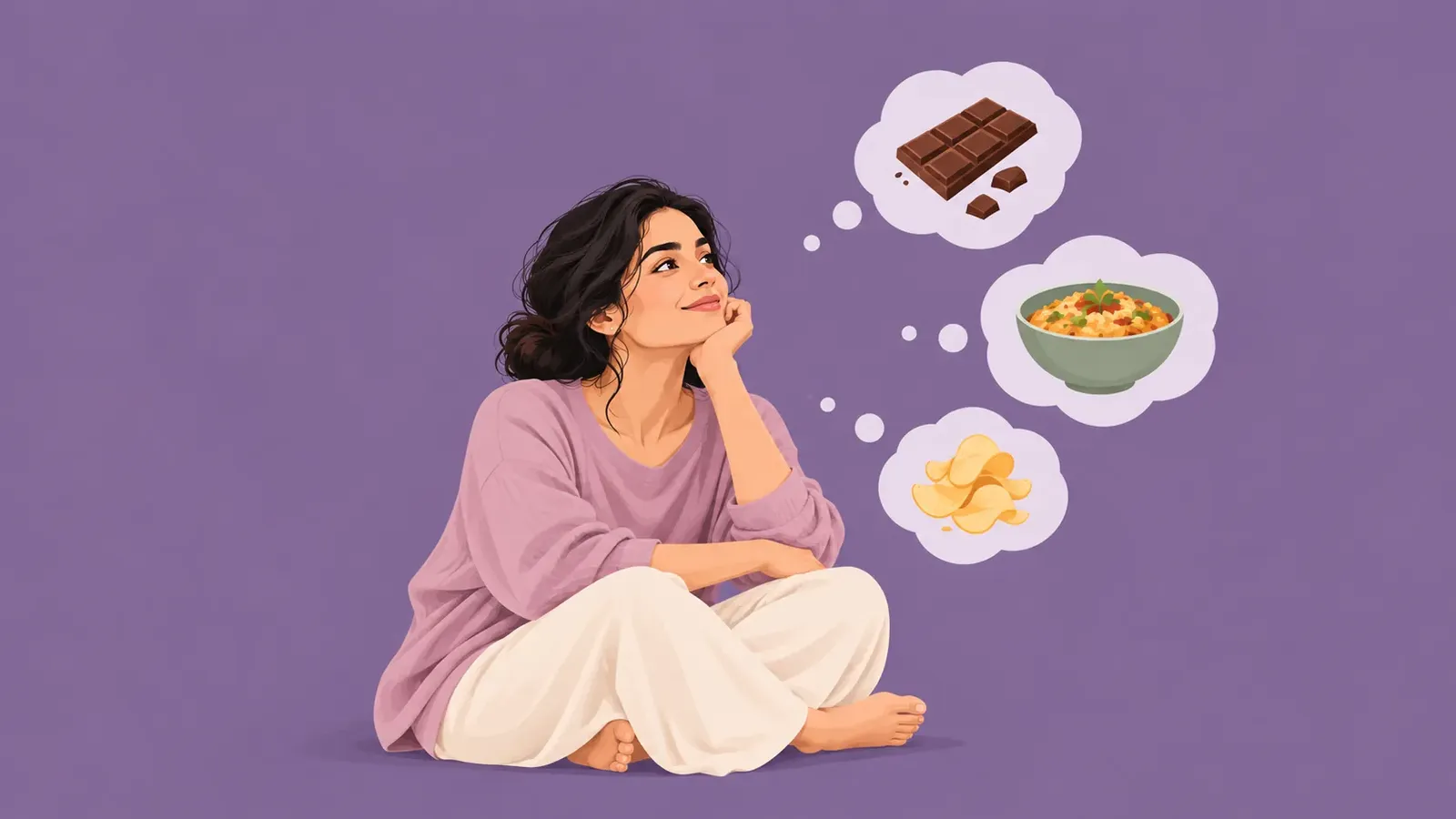
Have you ever noticed that you can go through the first half of your cycle feeling quite comfortable around food, and then, before your period, suddenly feel as though your appetite has turned up a notch?
You may want a larger meal. You may snack more. You may find yourself thinking about chocolate, something salty, or simply food in general.
There is some science behind this.
But there is also a lot of noise.
Research suggests that energy intake may be somewhat higher during the luteal phase—the part of the cycle after ovulation and before the next period—than during the follicular phase. A 2024 systematic review and meta-analysis of 15 datasets involving 330 women found an average difference of about 168 kcal per day between the phases, with higher intake in the luteal phase. 1
That does not mean every woman needs 168 extra calories every day.
And it certainly does not mean that every craving is a hormonal message.
The Signal: Your Appetite Can Change
The menstrual cycle involves changing levels of estrogen, progesterone and other hormones. These changes can influence appetite, energy regulation and eating behaviour.
The strongest overall evidence suggests that food intake tends to be somewhat lower around the follicular phase and higher during the luteal phase, although the size of the change varies considerably between people and from cycle to cycle. A major review also highlighted that the available research remains limited and that individual responses can be quite different. 2
There is an interesting detail here: the science is not as neat as the internet makes it sound.
A 2025 controlled study of 18 healthy women found no significant difference in appetite, food cravings or measured food intake between the late-follicular and mid-luteal phases. Resting metabolic rate also did not differ significantly, although it showed a tendency to be higher during the mid-luteal phase. 3
So both things can be true: some women experience increased appetite around the luteal phase, while others may notice little or no meaningful change.
Hunger Is Not the Same as a Craving
This distinction matters.
Hunger is the body’s drive to obtain food. It can build gradually and may be satisfied by a range of foods.
A craving is a strong desire for a particular food or eating experience. It can be influenced by hunger, reward, emotions, habits, the environment and the availability of highly palatable foods.
That means wanting chocolate before your period does not automatically mean your body is deficient in magnesium. Wanting carbohydrates does not automatically mean you need a particular nutrient. And having a stronger appetite does not mean you have “lost control.”
Food cravings are complex behaviours, and recent research continues to show that hunger, emotional state, food environment and individual differences can interact in determining when cravings occur. 4
The Noise: Do You Need a Different Diet for Every Phase?
This is where cycle nutrition becomes unnecessarily complicated.
You may have seen advice telling you to eat one specific group of foods during menstruation, completely change your diet around ovulation, avoid certain foods before your period or follow a rigid “cycle-syncing” meal plan.
The evidence does not justify treating every phase of the menstrual cycle as requiring its own special diet.
There may be genuine physiological changes in appetite and energy intake, but that is very different from proving that every woman needs a prescribed menu for each hormonal phase. The research itself remains heterogeneous, and individual responses vary. 1 2
So instead of asking, “What am I supposed to eat during this phase?”, a more useful question may be:
“What is my body actually telling me?”
Listen for the Signal, Not the Noise
If you notice that you are genuinely hungrier during the week or two before your period, you do not have to fight that hunger simply because you are trying to follow a calorie target.
Start with the basics.
Are you eating enough overall? Are your meals reasonably balanced? Are you getting adequate protein and fibre? Have you been sleeping poorly? Are you stressed? Have you been restricting food earlier in the day or earlier in the cycle?
Sometimes what feels like a mysterious hormonal craving has a much simpler explanation.
And sometimes you really are hungrier.
That is not a failure.
A Better Way to Think About Your Cycle and Food
Instead of trying to eat “perfectly” for every hormonal phase, pay attention to your own pattern over several cycles.
You could notice whether your appetite changes, when cravings occur, whether sleep changes at the same time, and whether your symptoms are associated with PMS.
A simple cycle-and-food diary can be more useful than following a generic chart that assumes every woman’s body behaves identically.
And if your appetite becomes dramatically different, you experience recurrent binge eating, feel distressed about food, or your eating patterns are interfering with your health or daily life, that deserves proper attention rather than being dismissed as “just hormones.”
KEY TAKEAWAYS
- Appetite can change across the menstrual cycle, and research generally finds somewhat higher energy intake during the luteal phase. 1
- The size of this change varies, and some women may notice very little difference. 2
- Hunger, food cravings and emotional eating are not the same thing.
- A craving does not automatically mean you have a nutrient deficiency.
- You do not need a rigid diet designed around every phase of your cycle.
- Tracking your own pattern can be more useful than following generic “cycle-syncing” rules.
- Eating enough, sleeping well and avoiding unnecessary restriction can make it easier to understand your genuine hunger signals.
REFERENCES
- Tucker JAL, McCarthy SF, Bornath DP, Khoja JS, Hazell TJ. The Effect of the Menstrual Cycle on Energy Intake: A Systematic Review and Meta-analysis. Nutrition Reviews. 2025;83(3):e866–e876.
- Dalvit-Spilman M, et al. Dietary energy intake across the menstrual cycle: a narrative review. Nutrition Reviews. 2023. https://pubmed.ncbi.nlm.nih.gov/36367830/
- Energy intake and appetite in laboratory and free-living conditions may be consistent across menstrual cycle phases. 2025. https://pubmed.ncbi.nlm.nih.gov/41005066/
- Burkard A, et al. Bidirectional associations between affect and food craving within and between individuals: A mega-analysis. Appetite. 2025;209:107936. https://doi.org/10.1016/j.appet.2025.107936