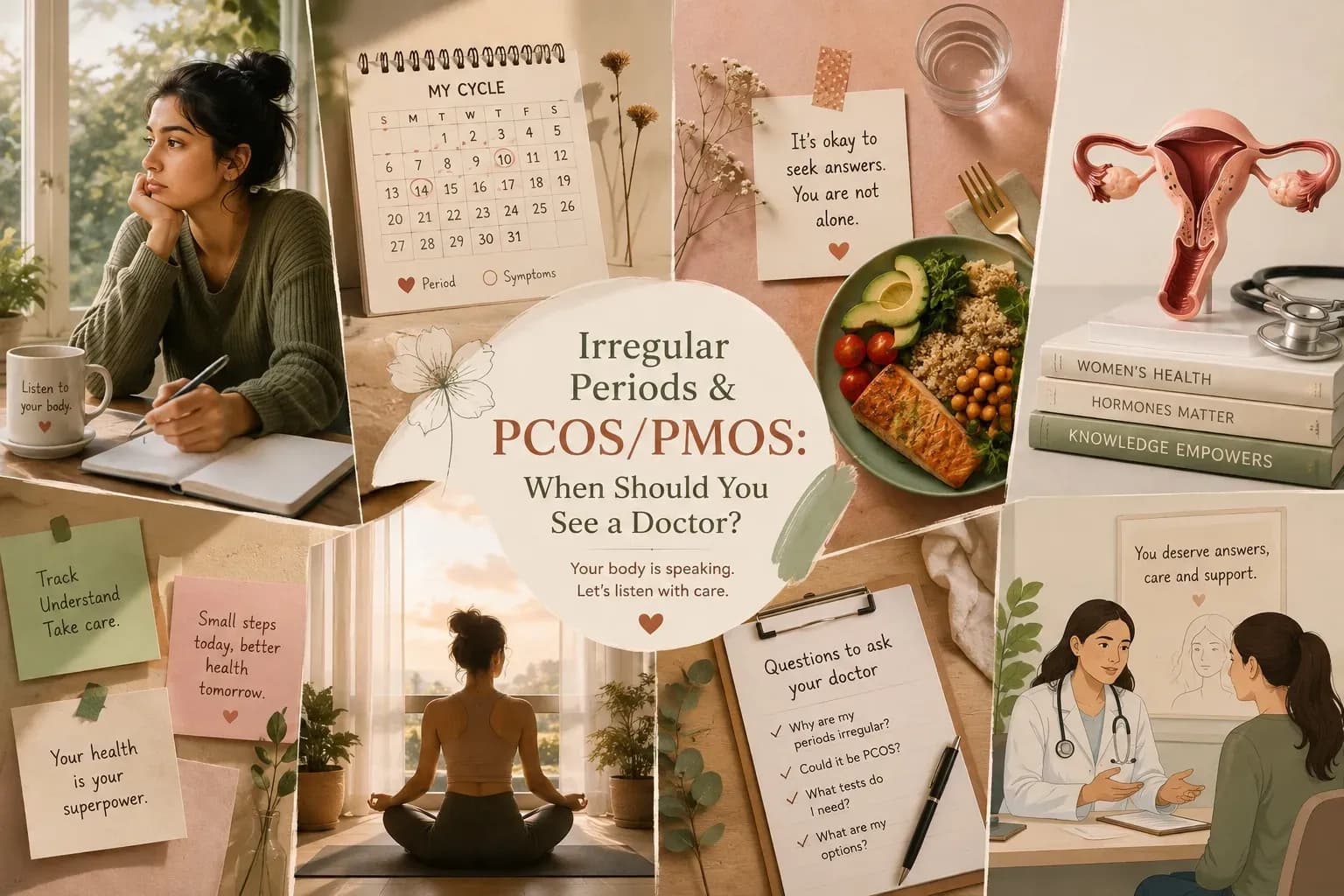
“My periods are becoming irregular. Does this mean I have PCOS?”
If that thought has crossed your mind, it is understandable. When your cycle changes, it is easy to worry about PCOS or fertility. But an irregular period is worth understanding — not immediately diagnosing.
PCOS, now also referred to as PMOS, is one possible reason among several. Start with the pattern.
FROM THE DOCTOR’S DESK
“An irregular period is a clue, not a conclusion. We look at the whole picture — your menstrual pattern, symptoms, medical history and possible causes — before deciding whether PCOS should be considered.”
— Dr. Sowmya Sampurna E
So, when does an irregular period need medical attention?
QUICK ANSWER
For adults, periods that repeatedly become unusually frequent, infrequent or unpredictable are worth discussing with a doctor. Going more than 90 days without a period also deserves evaluation.
PCOS may be one possible explanation, but pregnancy, thyroid problems, major weight changes, stress, excessive exercise, some medicines and other conditions can also affect periods.
First, what counts as “irregular”?
For adults more than three years after their first period, cycles shorter than 21 days, longer than 35 days, fewer than eight cycles a year, or a gap of more than 90 days without a period are considered irregular under the 2023 international PCOS guideline.
For teenagers, the picture is more nuanced. Cycles can naturally take time to settle after the first period, and what counts as irregular depends on how long it has been since menarche. Adult cycle criteria should therefore not simply be applied to teenagers.
Does an irregular period mean PCOS?
Not necessarily.
PCOS can affect ovulation, making periods less frequent or unpredictable. It may also be associated with higher androgen activity, which can show up as unwanted facial or body hair, persistent acne or scalp hair thinning.
But PCOS is only one possible explanation. Pregnancy, thyroid disorders, major weight changes, intense exercise, stress, some medicines and other conditions can also affect your cycle.
So if you are thinking, “I have irregular periods, therefore I have PCOS,” pause there.
An irregular period is one piece of the picture — not the whole picture.
When should you book an appointment?
Speak with a doctor if:
- your previously regular periods become irregular for several months;
- your cycles repeatedly fall outside the usual range;
- you go more than 90 days without a period;
- new facial or body hair, persistent acne or scalp hair thinning appear alongside changes in your cycle; or
- you are trying to conceive and your cycles are consistently irregular.
Your doctor may ask about your cycle history, the possibility of pregnancy, medicines and other symptoms. Testing will depend on your history and examination.
Seek prompt medical care for very heavy bleeding, especially if you are soaking through a pad or tampon every hour or if the bleeding is accompanied by dizziness, fainting or significant weakness.
What can you do before your appointment?
Keep a simple record of your cycles. Note the first day of each period and the number of days before your next period begins. Also note any changes in acne, hair growth, weight, medicines, stress or exercise.
This gives your doctor useful information about the pattern.
You also do not need to order a long list of “PCOS hormone tests” yourself. Diagnosis is a clinical process that considers your symptoms, medical history and, where appropriate, further evaluation.
WHAT YOU CAN DO NOW?
- Track your cycles.
- Note any symptoms that occur alongside changes in your cycle.
- If pregnancy is possible and a period is late, take a pregnancy test.
- Book an appointment if the pattern persists or worries you.
FREQUENTLY ASKED QUESTIONS
Can I have PCOS if my periods are regular?
Yes. Regular-looking cycles do not completely exclude PCOS. Your overall clinical picture matters.
Can acne and irregular periods be signs of PCOS?
They can occur with PCOS, but they do not prove it. Other causes are possible.
Do I need an ultrasound to know if I have PCOS?
Not necessarily. In adults, diagnosis can often be made from the appropriate combination of clinical or biochemical features after other causes are considered. Not everyone being evaluated for PCOS needs an ultrasound, and an ultrasound alone does not diagnose PCOS.
KEY TAKEAWAYS
- Irregular periods do not automatically mean PCOS.
- A persistent change in your cycle is worth discussing with a doctor.
- PCOS is diagnosed from a combination of features, not one symptom.
An irregular period is a reason to understand your body — not a reason to fear it.
You do not need to arrive with a diagnosis. Bring your cycle history, your questions and the changes you have noticed.
Then start with one simple question:
“What could be causing this, and what should we do next?”
PCOS is a health condition, not a verdict on your body or your future.
REFERENCES
- Teede HJ, et al. 2023 International Evidence-based Guideline for the Assessment and Management of PCOS.
- International PCOS Network. International Evidence-based Guideline for PCOS. Monash University.
- American College of Obstetricians and Gynecologists. Amenorrhea: Absence of Periods.
- American College of Obstetricians and Gynecologists. Abnormal Uterine Bleeding.
- Bharali MD, et al. Prevalence of Polycystic Ovarian Syndrome in India: A Systematic Review and Meta-Analysis. Cureus. 2022.