Quick Answer
PCOS (PMOS) can contribute to acne, particularly when increased androgen activity affects the skin’s oil glands.Insulin resistance may also contribute to the hormonal environment associated with acne. However, acne alone does not diagnose PCOS (PMOS). If acne occurs alongside irregular periods, excess facial or body hair, scalp hair thinning or difficulty conceiving, it may be worth discussing a broader hormonal assessment with your doctor. 1
Introduction
You may have noticed a frustrating pattern: your periods become irregular, unwanted facial hair appears, and suddenly your skin is breaking out like you’re a teenager again.
If you have PCOS (PMOS), you may wonder: “Is my acne hormonal?”
Sometimes, yes. But acne alone does not diagnose PCOS (PMOS), and having PCOS (PMOS) does not mean you will necessarily have acne. 1
From the Doctor’s Desk
Acne can sometimes be the visible part of a much larger hormonal picture, but it should not be interpreted in isolation.
In PCOS (PMOS), increased androgen activity can influence the skin and contribute to excess oil production and acne. Insulin resistance may also interact with androgen pathways. At the same time, acne by itself is a relatively weak predictor of biochemical hyperandrogenism, so having acne does not automatically mean that you have PCOS (PMOS). 1 2 3
For Indian women, it is also important to remember that PCOS (PMOS) is not an uncommon condition. A systematic review and meta-analysis of Indian studies found that the pooled prevalence varied according to the diagnostic criteria used, highlighting both the burden of the condition and the importance of proper assessment rather than self-diagnosis. 5
If acne is persistent, severe, scarring, or accompanied by changes such as irregular periods, excess facial hair or scalp hair thinning, look at the whole pattern rather than treating the skin in isolation. Your dermatologist and gynaecologist can help determine whether you need skin-directed treatment, hormonal assessment, or both.
The Hormone–Skin Connection
Androgens—including testosterone—can stimulate the sebaceous glands to produce more sebum. Excess sebum, blocked hair follicles and inflammation can all contribute to acne.
PCOS (PMOS) can involve increased androgen activity. Insulin resistance may also contribute by influencing androgen production and reducing sex-hormone-binding globulin, potentially increasing free testosterone. 2 3
Think of it as a conversation between your ovaries, insulin and skin.
When that hormonal environment changes, your skin may notice.
Why Does PCOS (PMOS) Acne Often Feel Different?
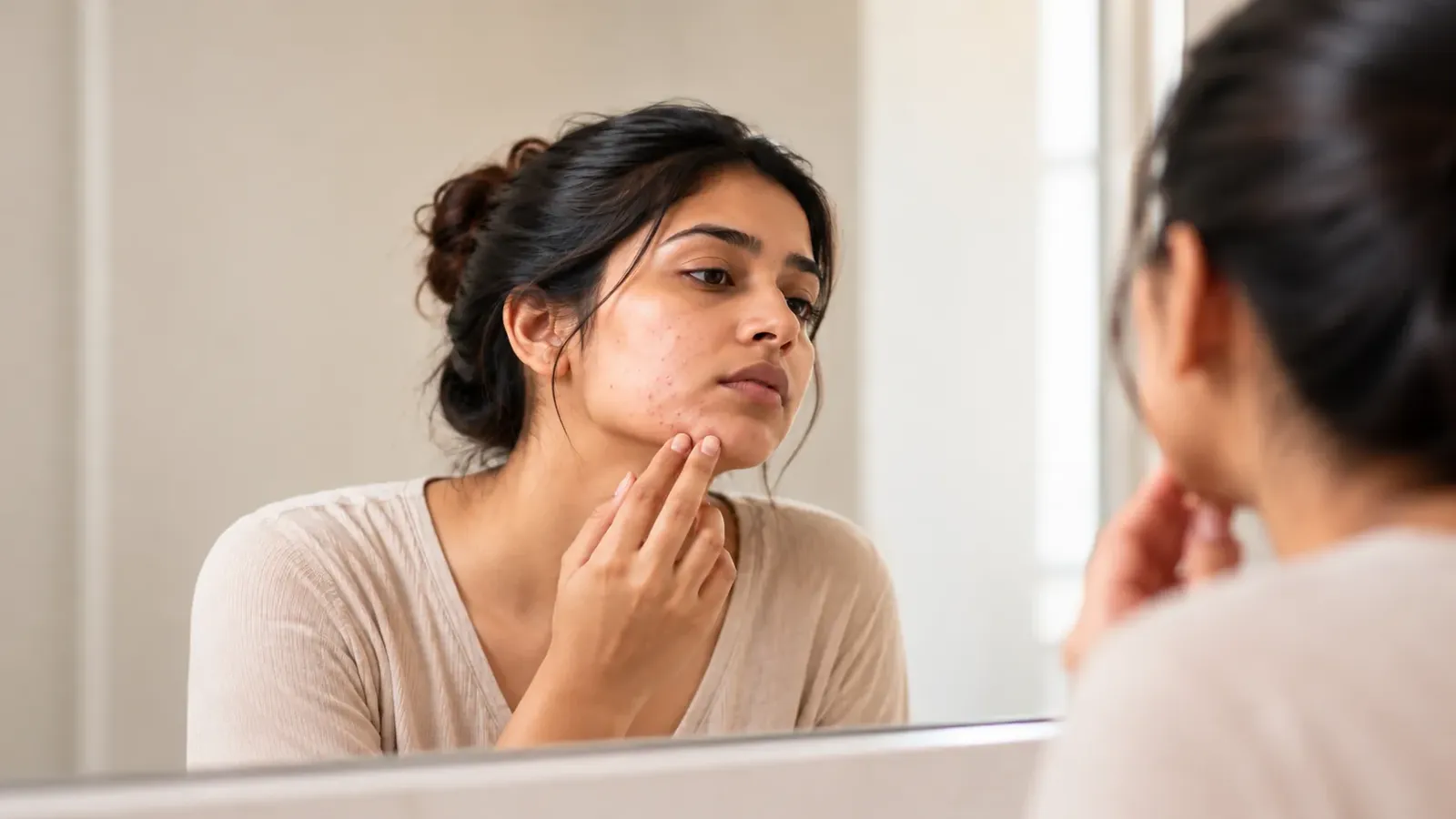
Hormonal acne can appear around the:
- Jawline
- Chin
- Lower cheeks
It may be persistent, inflammatory or repeatedly return despite ordinary skincare.
But location alone cannot tell you whether acne is hormonal.
And this is important: the 2023 international PCOS (PMOS) guideline says acne on its own is a relatively weak predictor of biochemical hyperandrogenism. Hirsutism is more strongly associated with androgen excess. 1
So one pimple—or even persistent acne—doesn’t mean you have PCOS (PMOS).
When Should Acne Make You Think Beyond Skincare?
Consider discussing a hormonal evaluation with your doctor if acne occurs alongside features such as:
- Irregular or infrequent periods
- Excess facial or body hair
- Scalp hair thinning
- Difficulty conceiving
- Other signs suggesting androgen excess
Your doctor may look at your menstrual history, symptoms and examination before deciding whether hormone testing is appropriate. The 2023 guideline recommends total and free testosterone as the preferred biochemical assessment of hyperandrogenism when testing is indicated. 1
You don’t need to order a “female hormone panel” yourself.
Does Insulin Resistance Make Acne Worse?
It can be part of the picture.
Insulin resistance is common in PCOS (PMOS), and higher insulin levels can promote androgen production and reduce SHBG, increasing the amount of free androgen available to act on tissues such as the skin. 2 3
This does not mean:
“Acne = insulin resistance.”
Nor does it mean that eliminating sugar will automatically cure PCOS (PMOS) acne.
PCOS (PMOS) is a complex condition involving reproductive, hormonal and metabolic pathways.
Your skin is one clue—not the whole diagnosis.
So, How Is PCOS (PMOS)-Related Acne Treated?
You don’t have to choose between treating your skin and treating PCOS (PMOS).
Acne itself can be treated with evidence-based dermatological therapies such as topical retinoids, benzoyl peroxide, azelaic acid and other appropriate treatments, depending on severity and individual circumstances. 4
For women with PCOS (PMOS), hormonal treatment may sometimes be useful when appropriate. Combined oral contraceptive pills can help manage acne and other androgen-related symptoms in suitable women. Anti-androgen medicines such as spironolactone may also be considered in selected cases, with appropriate contraception and medical supervision. 1 4
If pregnancy is possible, some acne medicines—including retinoids and anti-androgens—require particular caution or are contraindicated. Do not start prescription acne treatment without telling your doctor that you may become pregnant. 4
And What About Diet?
Please don’t let acne push you into an extreme “PCOS (PMOS) diet.”
A healthy eating pattern, regular physical activity and management of metabolic health are important parts of PCOS (PMOS) care, but there is no single diet proven to cure PCOS (PMOS) or guarantee clear skin. The international guideline emphasises sustainable healthy lifestyle approaches rather than one specific dietary prescription. 1
If you have PCOS (PMOS) with insulin resistance, managing your overall metabolic health is worthwhile—but your acne may still need direct dermatological treatment.
When Should You See a Dermatologist?
See a dermatologist if your acne is:
- Painful or deep
- Leaving scars or dark marks
- Persistent despite appropriate skincare
- Affecting your confidence or mental wellbeing
- Suddenly becoming severe
And if acne appears alongside rapidly worsening facial hair, scalp hair loss or other signs of significant androgen excess, speak with your doctor promptly. Markedly elevated or rapidly progressive androgen-related symptoms can require investigation for causes other than PCOS (PMOS). 1
Your Skin Is Not Failing You
PCOS (PMOS) can make your skin more difficult to manage—but acne is not a measure of how well you are managing your PCOS (PMOS).
You don’t need to scrub harder, buy ten products or blame yourself for eating one piece of chocolate.
Understand the hormonal picture.
Treat the acne.
Look after your metabolic health.
And if the pattern doesn’t make sense, let your doctor connect the dots.
Key Takeaways
- PCOS (PMOS)-related androgen activity can contribute to acne by increasing sebum production and follicular changes. 2 3
- Acne alone is not enough to diagnose PCOS (PMOS) and is a relatively weak predictor of biochemical hyperandrogenism. 1
- Irregular periods, hirsutism or scalp hair thinning alongside acne make hormonal assessment more relevant. 1
- PCOS (PMOS) acne can require both standard dermatological treatment and, when appropriate, hormonal treatment. 1 4
- There is no single “PCOS (PMOS) acne diet” that guarantees clear skin. 1
- Severe, scarring or rapidly worsening acne deserves professional care.
References
[1] International PCOS Network. 2023 International Evidence-Based Guideline for the Assessment and Management of PCOS. ASRM — 2023 PCOS Guideline
[2] Damoulaki A, et al. Polycystic Ovary Syndrome-Associated Acne: The Interplay of Hyperandrogenism, Insulin Resistance, and Therapeutic Strategies. Cureus. 2025. PubMed — PCOS-Associated Acne Review
[3] Housman E, Reynolds RV. Polycystic ovary syndrome: a review for dermatologists: Part I. Diagnosis and manifestations. Journal of the American Academy of Dermatology. PubMed — PCOS Dermatology Review
[4] American Academy of Dermatology. Acne Clinical Guideline. Updated 2024. AAD — Acne Clinical Guideline
[5] Bharali MD, et al. Prevalence of Polycystic Ovarian Syndrome in India: A Systematic Review and Meta-Analysis.Cureus. 2022. PubMed — PCOS in India