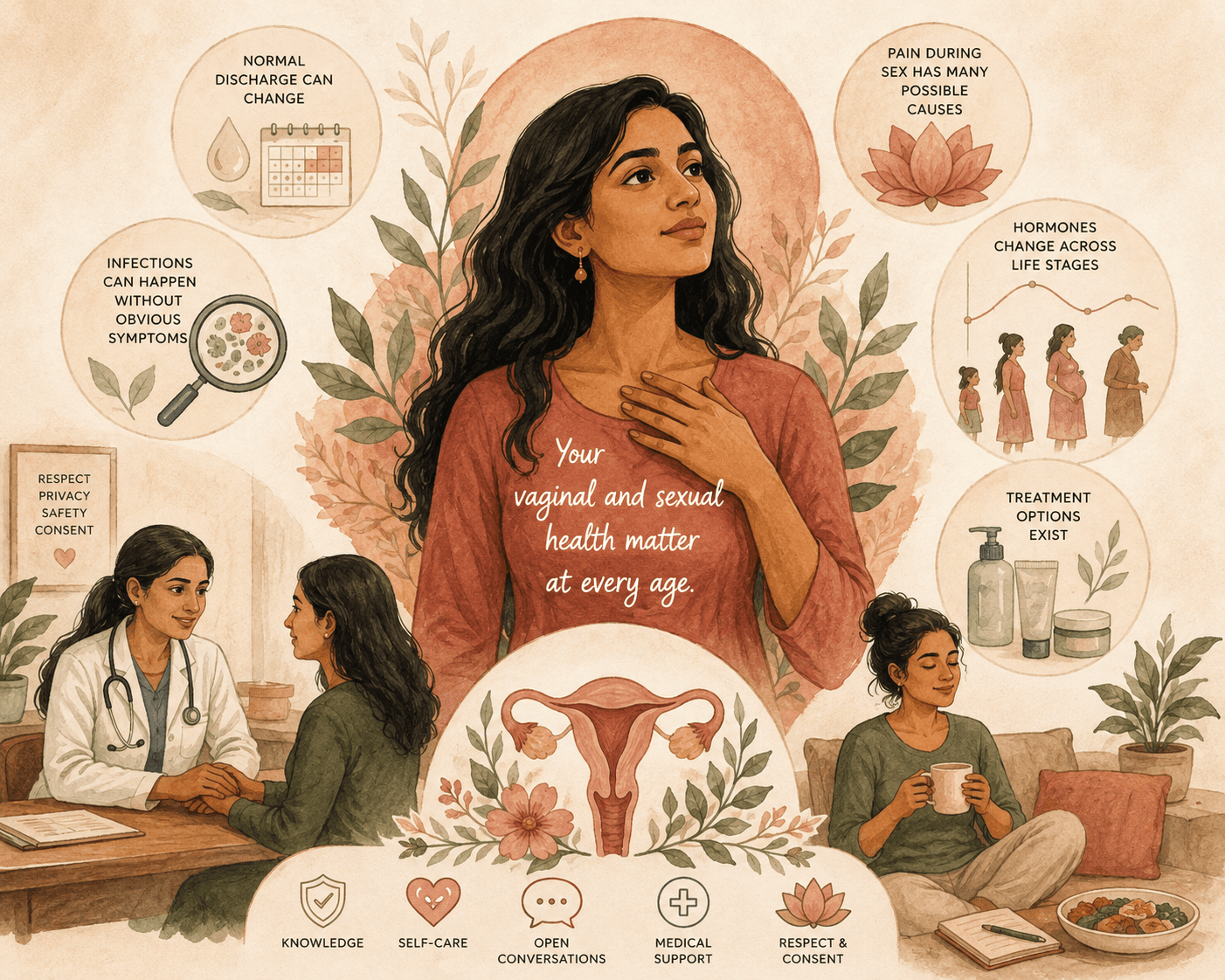
There are some questions women quietly carry for years.
“Is this discharge normal?”
“Why does sex hurt now?”
“Why don’t I feel interested in sex anymore?”
“Is something wrong with my vagina?”
Sometimes the answer is simple. Sometimes your body is responding to hormones, pregnancy, breastfeeding, stress or menopause. Sometimes there is an infection, pelvic-floor problem, medication effect or another medical condition that deserves treatment.
And sometimes nothing is “wrong” at all. Sexual desire, arousal and pleasure naturally vary across people and across life.
WHO describes sexual health as physical, emotional, mental and social wellbeing in relation to sexuality—not simply the absence of disease. It also emphasises safety, respect, consent and freedom from coercion, discrimination and violence. 1
Your vaginal and sexual health deserve that same broader understanding.
Not embarrassment.
Not silence.
And certainly not the assumption that discomfort is something you simply have to tolerate.
What Actually Happens to Your Hormones?
Your vulva and vagina respond to changes in hormones throughout life.
Estrogen supports the health, thickness, elasticity and natural lubrication of vaginal tissues. During puberty, increasing estrogen contributes to maturation of the reproductive system. During the reproductive years, vaginal discharge can vary with the menstrual cycle and around ovulation.
Pregnancy brings further changes, and breastfeeding can temporarily lower estrogen levels. Later, during perimenopause and menopause, estrogen levels decline and vaginal tissues may gradually become thinner, drier and less elastic.
This is why the same woman can experience very different vaginal symptoms at different stages of life.
But hormones are not the whole story.
Stress, medications, infections, pelvic-floor muscles, relationship factors, mental health, childbirth and chronic illnesses can all influence sexual wellbeing.
Your Vaginal Health Changes Across Life
During adolescence, learning what is normal can prevent unnecessary fear. Vaginal discharge usually begins around puberty and can vary in amount and consistency. Normal discharge is generally clear or white and does not have a strong unpleasant smell.
During the reproductive years, discharge may become wetter around ovulation. Sexual activity, pregnancy and hormonal contraception can also change the amount.
During pregnancy, increased discharge is common. However, discharge that becomes foul-smelling, green or yellow, or is associated with itching, soreness or painful urination deserves assessment.
After childbirth, vaginal and vulvar tissues may need time to heal. Tears, episiotomy, pelvic-floor changes and breastfeeding-related low estrogen can contribute to soreness, dryness or painful sex.
After menopause, lower estrogen can cause genitourinary syndrome of menopause (GSM)—a group of vaginal, vulvar and urinary symptoms including dryness, burning, painful sex, urinary urgency and recurrent urinary infections.
These changes are common.
They are also treatable. 5
Vaginal Discharge Is Not Automatically an Infection
This is one of the most important distinctions in vaginal health.
Normal vaginal discharge helps keep the vagina moist and healthy. It can be clear, white, slippery, wet, thick or sticky depending on where you are in your cycle.
What deserves attention is a change from your usual pattern, particularly when discharge is accompanied by:
- strong or unpleasant odour
- yellow, green or frothy discharge
- intense itching or burning
- pain during urination
- pelvic pain
- bleeding between periods or after sex
- sores or blisters
Possible causes include bacterial vaginosis, candidiasis, trichomoniasis, cervicitis and other infections. An STI can also occur without obvious symptoms, so appearance alone cannot reliably identify the cause. 2
Do not repeatedly self-treat with over-the-counter antifungals or antibiotics without knowing what you are treating.
A symptom that looks like “yeast infection” may not be one.
Indian primary-care research also illustrates why this matters: in one study of 138 women with reproductive-age vaginal discharge, 30.4% had an identified infective cause, with bacterial vaginosis, Candida and Trichomonas among the findings.
This was a specific clinical population, not a prevalence estimate for all Indian women.
The Symptoms We Talk About Less
Vaginal health is not only about discharge.
Women may experience:
- vaginal dryness
- burning or irritation
- itching
- painful sex
- difficulty with penetration
- reduced lubrication
- reduced sexual desire
- difficulty becoming aroused
- difficulty reaching orgasm
- pelvic-floor tightness
- urinary urgency or recurrent UTIs
Pain during sex is particularly important.
ACOG notes that painful sex can arise from vaginal dryness, infections, pelvic-floor problems, endometriosis, vulvodynia, childbirth-related injury and other conditions. Emotional stress, fear, relationship difficulties and some medications can also affect sexual response. 4
In India, the problem is often compounded by silence. A study of 153 fertile women in Ahmedabad found female sexual dysfunction in 55.55% of participants, while another Indian review highlights substantial under-reporting and reluctance to seek help. These studies were not nationally representative, but they illustrate how easily sexual concerns can remain untreated. 7 8
You do not need to wait until a problem becomes severe before discussing it.
What Happens to Your Body After Childbirth and During Menopause?
Pregnancy and childbirth can temporarily—or sometimes persistently—change sexual wellbeing.
Perineal tears, episiotomy, pelvic-floor dysfunction, scar tissue, fatigue, body-image changes and breastfeeding-related low estrogen can all influence comfort and desire.
There is no universal timetable at which every woman should feel ready for sex again.
If sex is painful, stop and seek help rather than repeatedly pushing through the pain. 4
Later, menopause can bring another shift. Reduced estrogen may cause dryness, burning, reduced lubrication and painful sex. ACOG notes that vaginal moisturisers and lubricants can help, while low-dose local vaginal estrogen may be considered when appropriate. 5
The right treatment depends on your symptoms, medical history and individual risks.
What Indian Women May Need More Of
Vaginal and sexual health in India is shaped by more than biology.
Privacy can be limited. Conversations about sex may be uncomfortable. Women may be expected to tolerate pain within marriage. Young women may be afraid that asking questions will be judged as inappropriate. Older women may be told that sexual discomfort is simply part of ageing.
It should not be.
India’s National Health Mission maintains national guidelines for prevention and management of reproductive-tract infections and STIs, reinforcing that these are healthcare issues rather than matters of shame. 6
Women also need access to confidential consultations, affordable testing, contraception and STI prevention, HPV vaccination where appropriate, pelvic-floor care, menopause care and accurate information in languages they understand.
Sexual health is healthcare.
Treatment: You Have Options
Treatment depends entirely on the cause.
For irritation caused by harsh products, removing the irritant may be enough. Avoid douching, scented vaginal products, perfumed wipes and other products that can irritate vulvar tissue. 3
For vaginal dryness, moisturisers can provide ongoing moisture, while lubricants can reduce friction during sexual activity. Water- or silicone-based lubricants are commonly used; oil-based products can damage latex condoms. 5
For infections, treatment depends on the actual diagnosis. Antibiotics, antifungals or other medicines should not be chosen solely from symptoms.
For persistent sexual pain, treatment may involve pelvic-floor physiotherapy, medical treatment, counselling or sex therapy depending on the underlying cause. 4
For GSM after menopause, local vaginal estrogen is one option when appropriate. Women with a history of hormone-sensitive cancer or other complex medical circumstances should discuss treatment with their specialist. 5
And remember:
Treatment is not only about making sex possible. It is about making your body comfortable and your life better.
What About Supplements?
This is where vaginal-health marketing can become louder than science.
There is no universal supplement that “cleanses” the vagina, balances hormones or prevents every vaginal infection.
Probiotics, herbal products and intimate-health supplements may be marketed aggressively, but evidence varies by product and condition.
Do not insert home remedies, oils, herbs or household substances into the vagina.
The vagina has its own microbial environment and does not need to be “detoxed.”
If you have recurrent symptoms, the better question is not:
“What should I take?”
It is:
“What is causing this?”
Exercise, Food and Sleep: The Foundation
There is no special diet that guarantees perfect vaginal or sexual health.
A balanced Indian diet with adequate protein, vegetables, fruits, pulses, whole grains, nuts, seeds and appropriate dairy or alternatives supports overall health.
Regular physical activity supports cardiovascular health, mood and general wellbeing. Pelvic-floor exercises can be useful for some women, particularly for urinary symptoms, but pelvic-floor muscles can also be excessively tight. In that situation, repeatedly doing strengthening exercises without assessment may not solve the problem.
Sleep matters too.
Fatigue, new motherhood, chronic stress and menopause can all affect sexual desire and arousal. A temporary reduction in interest does not automatically mean that your relationship or sexuality has changed permanently.
Your Mental Health Matters
Sexual wellbeing lives partly in the body and partly in the mind.
Stress, anxiety, depression, fear of pain, body-image concerns, relationship conflict and previous trauma can influence desire, arousal and comfort.
That does not mean sexual symptoms are “all in your head.”
Pain is real.
Dryness is real.
And anxiety can make an already painful physical experience even harder.
A good assessment looks at both.
WHO also emphasises that sexual health includes emotional and social wellbeing, respectful relationships and freedom from coercion. 1
You never owe anyone sex because you are married, because you have been together for years, or because you said yes before.
Consent matters every time.
From the Doctor’s Desk
Women often delay discussing vaginal or sexual symptoms because they feel embarrassed or assume that discomfort is normal. But persistent discharge, itching, dryness, painful intercourse or changes in sexual function deserve a respectful medical conversation. The cause may be simple and treatable, but it is important to identify it rather than repeatedly self-medicate or tolerate symptoms.
— Dr. Sowmya Sampurna E
Key Takeaways
- Your vagina is part of your body.
- Your sexuality is part of your wellbeing.
- Neither should become a source of shame simply because society has made these conversations uncomfortable.
- Discharge can be normal. Dryness can happen after childbirth or menopause. Desire can change. Sexual pain can have many causes.
- But persistent symptoms deserve an explanation.
- You do not have to decide whether something is “serious enough” to ask.
- You can simply say:
“Something has changed, and I want to understand why.”
That is enough. - Vaginal and sexual health matter throughout a woman’s life, not only during the reproductive years.
- Normal vaginal discharge is usually clear or white and does not have a strong unpleasant smell.
- A change in discharge, especially with itching, burning, pain or odour, deserves assessment.
- STIs can occur without obvious symptoms.
- Pain during sex is common but is not something women should simply tolerate.
- Childbirth, breastfeeding, medications, pelvic-floor problems and menopause can affect sexual comfort.
- Vaginal dryness after menopause can often be treated.
- Avoid douching, scented intimate products and unproven vaginal remedies.
- Sexual wellbeing is influenced by physical, emotional, relationship and social factors.
- Confidential, respectful medical care is appropriate at every age.
Frequently Asked Questions
Is white vaginal discharge normal?
Often, yes. Clear or white discharge without a strong unpleasant smell can be normal and may change during the menstrual cycle. A new change in smell, colour, texture or associated symptoms should be assessed.
Does vaginal discharge mean I have an infection?
Not necessarily. Normal discharge is common. Infections become more likely when discharge changes and is accompanied by itching, burning, pain, unpleasant odour or other symptoms. 2
Why does sex hurt?
Possible causes include dryness, infections, pelvic-floor problems, endometriosis, vulvar pain conditions, childbirth-related injury and hormonal changes. Stress and fear can also contribute. Persistent or severe pain deserves medical assessment. 4
Can breastfeeding cause vaginal dryness?
Yes. Lower estrogen during breastfeeding can contribute to vaginal dryness and painful sex. Lubricants may help, and persistent symptoms can be discussed with an obstetrician-gynaecologist. 5
Can menopause affect sexual health?
Yes. Lower estrogen can cause vaginal dryness, reduced lubrication, burning and painful sex, as well as urinary symptoms. Treatments are available. 5
Should I use intimate washes to keep my vagina clean?
Usually, no. The vagina cleans itself. Perfumed washes, douches and scented wipes can irritate vulvar tissue. Gentle external washing is generally sufficient. 3
When should I see a doctor?
Seek medical advice for persistent or recurrent discharge changes, genital itching or sores, pelvic pain, painful urination, bleeding after sex, persistent vaginal dryness or pain during sex, or any symptom that concerns you. 4
References
[1] World Health Organization. Sexual Health: Working Definition and Framework.Direct source
[2] World Health Organization. Sexually Transmitted Infections (STIs). 2025.Direct source
[3] American College of Obstetricians and Gynecologists. Vulvovaginal Health.Direct source
[4] American College of Obstetricians and Gynecologists. When Sex Is Painful.Direct source
[5] American College of Obstetricians and Gynecologists. Experiencing Vaginal Dryness? Here’s What You Need to Know.Direct source
[6] National Health Mission, Ministry of Health & Family Welfare, Government of India. National Guidelines on Prevention, Management and Control of Reproductive Tract Infections including Sexually Transmitted Infections.Direct source
[7] Mishra VV, Nanda S, et al. Prevalence of Female Sexual Dysfunction Among Indian Fertile Females. Journal of Mid-Life Health.Direct source
[8] Indian research review on female sexual dysfunction and under-reporting among Indian women.Direct source