That Chin or Jawline Pimple Before Your Period — Is It Hormonal Acne?
It is a familiar pattern: a few days before your period, a deep or tender pimple appears on your chin or jawline. It may settle after your period and return again the following month.
This pattern can be influenced by hormonal changes. But the location of acne alone cannot tell you whether you have a hormonal disorder.
The useful question is:
What pattern is my acne following, and are there other signs that suggest an underlying hormonal problem?
Quick Answer
Hormonal acne is a commonly used term for acne that appears to be influenced by hormonal fluctuations, particularly changes in androgen activity and the menstrual cycle.
Hormones can influence sebaceous gland activity, follicular changes and inflammation, making acne more likely or more persistent in some women. [1][2]
Chin and jawline acne is often associated with hormonally influenced adult acne, but jawline acne is a clue, not a diagnosis.
A predictable flare before your period, by itself, does not mean you have PCOS or another endocrine disorder.
The picture becomes more clinically important when acne occurs alongside irregular periods, increased facial or body hair, scalp hair thinning, or rapidly worsening androgen-related symptoms. [6]
What Is Adult Acne?
Adult acne generally refers to acne occurring in adulthood, with 25 years and older often used as a practical convention. It may persist from adolescence or begin for the first time in adulthood.
Adult female acne can have several contributing factors. Hormonal fluctuations, medications, skincare and hair products, stress and other individual factors can all influence the course of acne.
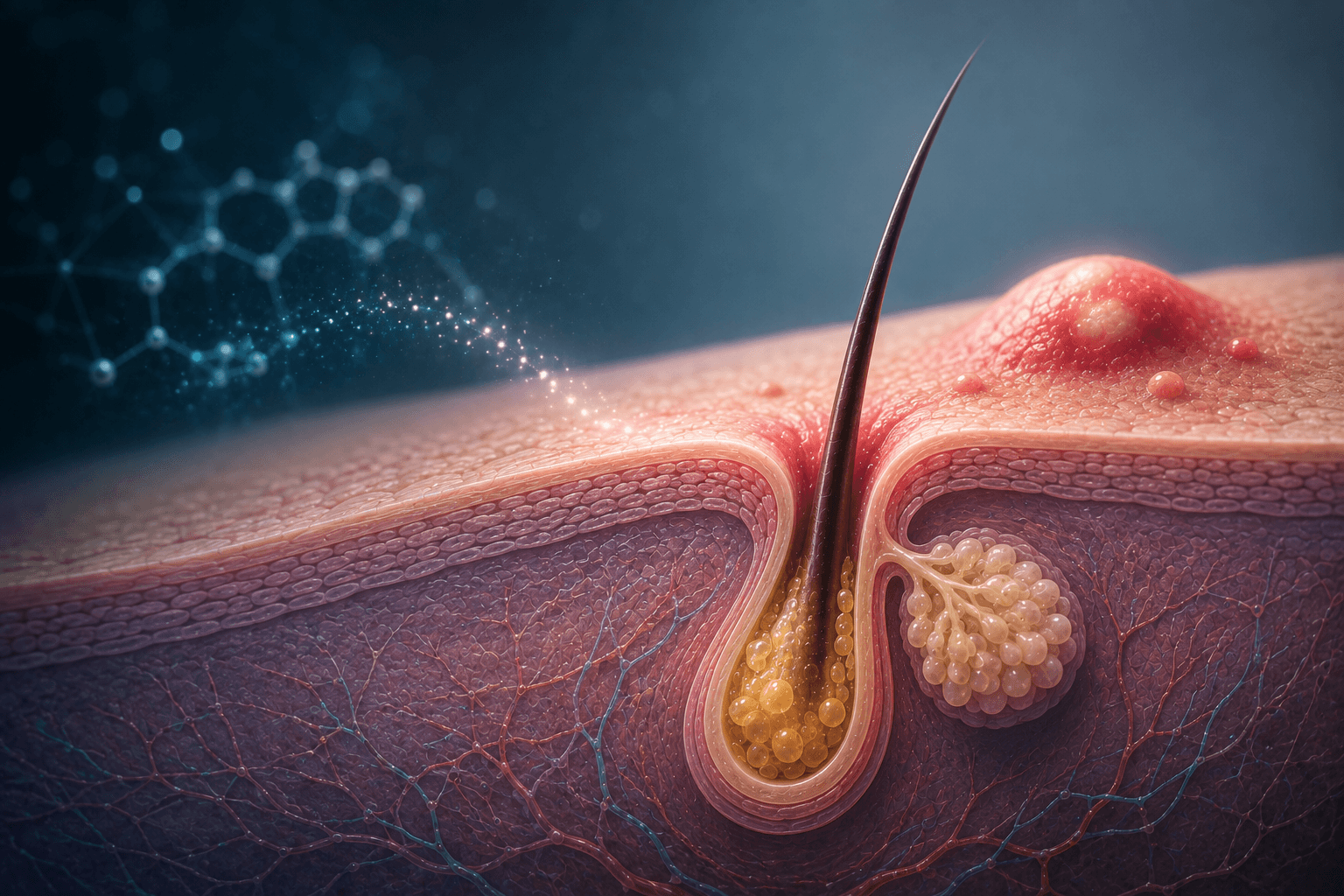
Acne itself is an inflammatory disorder of the pilosebaceous unit — the structure made up of a hair follicle and its associated sebaceous gland.
Several processes contribute to acne:
- increased sebum production
- abnormal shedding of cells inside the follicle
- blockage of the follicle
- changes involving Cutibacterium acnes (formerly Propionibacterium acnes)
- inflammation
These processes interact rather than occurring independently. Treatment therefore often combines medicines that target different parts of the acne pathway. [2]
What Does “Hormonal Acne” Actually Mean?
“Hormonal acne” is a commonly used term, but it is not a formal diagnosis that can be made simply by looking at where a pimple appears.
Androgens — including testosterone and related hormones — influence sebaceous glands. In acne-prone skin, androgen activity and sensitivity to androgens can promote sebum production and contribute to follicular changes and inflammation. [1]
This means hormonal fluctuations can affect acne even when blood hormone levels are within the expected range.
Hormonal influence does not automatically mean hormonal disease.
Why Does Acne Flare Before Your Period?
The menstrual cycle involves changing concentrations and relative effects of several reproductive hormones.
For some women, acne becomes more noticeable during the days before menstruation. The exact biological explanation for premenstrual acne flares is not completely established, but cyclical worsening is a recognised pattern in adult female acne. [1][3]
A recurring pattern such as:
period approaching → chin/jawline breakout → period begins → skin settles → cycle repeats
can therefore be clinically useful to notice.
But the pattern needs context.
A recurring premenstrual flare is different from acne accompanied by new irregular periods, excessive facial hair or rapidly progressive scalp hair loss.
Why the Chin and Jawline?
Adult female acne frequently involves the lower face, including the chin and jawline. This distribution is commonly associated with hormonally influenced acne, and hormonal treatments can be useful for some women with persistent lower-face acne. [1][2]
But there is no anatomical rule that says:
Jawline acne = hormonal disorder.
Acne distribution can provide a clue about the pattern of disease, but it cannot establish its cause on its own.
Two Women Can Have the Same-Looking Acne — But Need Different Evaluation
Woman A
She develops two or three chin pimples in the week before her period.
Her cycles are regular. She has no unusual facial hair or scalp hair thinning. The acne settles afterwards and follows the same pattern each month.
This is compatible with cyclically influenced acne. It does not, by itself, suggest PCOS.
Woman B
She initially notices a few recurring jawline breakouts before her period, but over time the acne becomes persistent rather than cyclical. Her periods also become increasingly irregular, and she notices new facial hair and progressive scalp hair thinning.
That broader pattern warrants assessment for hyperandrogenism rather than treating the acne in isolation. [6]
Does Chin Acne Mean PCOS?
No.
Acne alone is not enough to diagnose PCOS.
The 2023 International Evidence-based Guideline for PCOS states that acne in isolation, particularly without hirsutism, is a relatively weak predictor of biochemical hyperandrogenism. Assessment should consider the broader clinical picture rather than one symptom. [6]
PCOS becomes more relevant when acne occurs alongside features such as:
- irregular or infrequent periods
- excess facial or body hair
- scalp hair thinning consistent with androgen-related hair loss
- other clinical features suggesting androgen excess
Even then, diagnosis requires appropriate clinical assessment; acne plus one symptom does not automatically equal PCOS.
If you want to understand how PCOS is actually diagnosed, see PCOS Explained: Symptoms, Diagnosis, Metabolic Health & Treatment.
If your periods have become irregular, also see Irregular Periods: When Is It Normal and When Should You See a Doctor?
When Does Acne Suggest Androgen Excess?
Androgen excess can manifest through several different features.
Acne: particularly persistent adult acne or acne that is difficult to control.
Hirsutism: increased coarse hair growth in androgen-sensitive areas such as the face, chest or abdomen.
Scalp hair thinning: particularly a progressive pattern of androgen-related hair loss.
Menstrual changes: irregular, infrequent or absent periods.
The timing of these changes matters.
When Rapid Onset Is a Red Flag
Mild acne or gradually increasing facial hair over several years is more consistent with common causes of androgen excess such as PCOS. By contrast, symptoms that develop over months rather than years, particularly when several signs of virilisation appear together, require prompt medical assessment.
Rare causes include an androgen-secreting ovarian or adrenal tumour. [6]
Warning signs include:
- rapidly worsening acne or hirsutism
- deepening of the voice
- increased muscle bulk
- clitoromegaly
- rapidly progressive scalp hair loss
- marked menstrual disruption or amenorrhoea
These features are unusual in typical PCOS and warrant prompt medical evaluation for the source of androgen excess. [6]
Other causes of androgen excess can include non-classic congenital adrenal hyperplasia, hyperprolactinaemia, thyroid dysfunction and Cushing’s syndrome, as well as ovarian or adrenal tumours. The appropriate evaluation depends on the clinical pattern, examination and laboratory findings. [6]
Do You Need a Hormone Test?
There is no single “hormonal acne test.”
The clinical approach depends on the type of acne and the other symptoms present.
The 2023 International PCOS Guideline recommends total and free testosterone as the primary biochemical measures when assessing hyperandrogenism. If testosterone or free testosterone is not elevated, androstenedione and DHEAS may be considered, although the guideline notes that they have poorer specificity and that DHEAS declines with age. [6]
An AE-PCOS Committee expert report focused specifically on adult female acne has taken a broader position, recommending androgen assessment in women with adult acne, including total testosterone, free testosterone and DHEAS. [1]
These recommendations are not identical. The AE-PCOS Committee report advocates broader androgen testing in adult female acne, while the international PCOS guideline places greater emphasis on the overall clinical picture and gives greatest diagnostic value to biochemical testing when clinical signs of hyperandrogenism are minimal or absent. The broader AE-PCOS testing recommendation was subsequently challenged in a published Letter to the Editor. [1][6][8]
The practical message is that hormone testing should have a clinical purpose rather than being ordered simply because acne occurs on the chin or jawline.
Your clinician may consider testing based on:
- menstrual history
- acne pattern and severity
- hirsutism
- scalp hair changes
- other signs of androgen excess
- medications
- pregnancy status or plans
- the possibility of other endocrine conditions
Testing should answer a clinical question.
What Else Can Make Adult Acne Worse?
Hormones are only one part of the picture.
Adult acne can also be affected by skincare products, cosmetics, hair products, sweating, stress, medications and supplements. [3]
Some medicines are recognised causes of acneiform eruptions, including systemic corticosteroids, anabolic or androgenic steroids, lithium and high-dose vitamin B12. [9]
Protein supplements are sometimes reported by people with acne, but the evidence is less consistent than it is for established medication triggers. If acne changes noticeably after starting a new medicine or supplement, tell your clinician rather than stopping a prescribed medicine on your own.
In India, heat, humidity, sweating, cosmetic use and hair products can also be relevant to an individual's acne experience.
A hospital-based study of 110 adults with acne at a tertiary-care centre in Kerala found that 70 of the 89 women (78.7%) reported premenstrual worsening, while 6 (6.7%) reported irregular menstrual cycles. [4]
The study also recorded self-reported associations with food, cosmetics, stress, sunlight and sweating. Because this was a single-centre observational study based on participant reporting, these findings should not be interpreted as proof that these factors cause acne. [4]
What About Stress?
Stress may contribute to worsening acne in some people, but it is one factor among many. The Kerala study also recorded stress as a self-reported aggravating factor. [3][4]
Stress should therefore not be treated as the sole explanation for acne or as a reason to blame yourself.
Does Food Cause Hormonal Acne?
There is no universal “hormonal acne diet.”
The 2024 American Academy of Dermatology guideline found insufficient evidence to make broad dietary recommendations for acne treatment. [2]
That does not mean diet is irrelevant to every individual. It means that a reported food association should not automatically become a restrictive diet or a replacement for evidence-based acne treatment.
What About Skincare and Hair Products?
Look at what is actually touching your skin.
Heavy or occlusive cosmetics and some hair products can aggravate acne-prone skin. Hair oils are particularly relevant when they repeatedly come into contact with acne-prone areas. [3]
Another important issue in India is unsupervised use of steroid-containing combination creams. These can aggravate acneiform eruptions and cause other skin problems.
If your acne began or worsened after starting a cosmetic, hair product or medicated cream, tell your dermatologist exactly what product you used.
How Is Hormonal Acne Treated?
Treatment depends on the type and severity of acne, not simply whether someone calls it hormonal.
A dermatologist may consider:
- topical retinoids
- benzoyl peroxide
- azelaic acid
- salicylic acid
- topical antibiotics in appropriate combinations
- oral antibiotics for selected inflammatory acne
- combined oral contraceptives
- spironolactone
- isotretinoin for severe or treatment-resistant acne
Current acne guidelines support these approaches according to the clinical situation, with treatment selected based on severity, scarring risk, previous treatment, patient preferences and individual health factors. [2]
The PRACT-India consensus is particularly useful for India-specific treatment and practice considerations, including individualised treatment, topical retinoids, antibiotic stewardship and hormonal therapy for selected women. [5]
Hormonal Treatments
Two hormonal approaches commonly considered for appropriate women are combined oral contraceptives and spironolactone. Both have a role in selected patients with persistent adult female acne. [2][5]
Combined oral contraceptives are not suitable for everyone. A clinician will consider factors such as smoking, migraine with aura, and a history or risk of blood clots, alongside other individual contraindications.
Spironolactone is used off-label for acne. It can be effective for selected women, but it requires medical assessment because it can affect potassium levels, blood pressure and kidney function and can interact with other medicines. Routine potassium monitoring is not needed for every healthy younger patient, but testing becomes more important when risk factors for hyperkalaemia are present, such as kidney disease, relevant medical conditions or interacting medicines. [2]
Spironolactone requires effective contraception in women who can become pregnant.
Can Hormonal Contraception Affect Acne?
Hormonal contraception can affect acne in different directions.
Combined oral contraceptives can improve acne in some women because their hormonal effects reduce androgen activity at the skin. [2]
By contrast, some progestin-only contraceptives, including certain pills, implants and hormonal intrauterine devices, may be associated with acne in some users. However, the evidence does not establish a simple cause-and-effect relationship, and the effect varies by formulation and individual. [10]
Acne can also become noticeable after stopping a combined oral contraceptive that had been suppressing acne. This does not necessarily mean that the contraceptive caused the acne; an underlying acne tendency may simply become visible again after its protective effect is removed.
If your acne changes after starting or stopping contraception, mention the timing to your doctor. It can be an important part of the clinical history.
What About Antibiotics?
Oral antibiotics can be useful for selected moderate-to-severe inflammatory acne, but they should not become an indefinite treatment.
Current guidance recommends limiting systemic antibiotic use and combining antibiotic treatment with appropriate topical therapy, particularly benzoyl peroxide, to reduce antimicrobial resistance. Courses are generally limited to around three to four months, with reassessment of response and the need for continued treatment. [2]
Do not use leftover antibiotics, share someone else's prescription or continue an antibiotic course without medical review.
What About Isotretinoin?
Isotretinoin is one of the most effective treatments for severe or scarring acne and for acne that has not responded adequately to standard treatment. The AAD guideline strongly recommends it for severe acne, acne causing psychosocial burden or scarring, or acne that has failed standard oral or topical therapy. [2]
Isotretinoin must not be taken during pregnancy. It is a potent teratogen, and pregnancy prevention is mandatory for people who can become pregnant during treatment. [2][7]
Pregnancy must be avoided during isotretinoin treatment and for one month after stopping it. Patients should follow the specific instructions and product information provided by their prescriber. [7]
This is not a medicine to start based on an online recommendation or someone else's prescription.
Pregnancy Changes the Treatment Conversation
If you are pregnant, trying to conceive or breastfeeding, tell your doctor before starting or continuing acne treatment. [7]
Some commonly used acne medicines are unsuitable during pregnancy. These include isotretinoin, spironolactone and certain topical retinoids. Other treatments may be considered depending on the situation, but pregnancy-specific advice should come from your obstetrician, dermatologist or both. [2][7]
Do not stop a prescribed medicine without speaking to your clinician, but do not assume that an acne product is safe simply because it is sold over the counter.
What About Dark Marks and Scars?
Acne does not end when the pimple disappears.
In many Indian skin types, inflammation can leave post-inflammatory hyperpigmentation (PIH) — flat brown or dark marks that remain after the acne has healed. These are different from true acne scars, which involve structural changes in the skin.
Preventing new inflammatory lesions and avoiding picking can reduce the risk of pigmentation and scarring. Treatments such as azelaic acid can also have a role in acne and pigmentation management. [2]
Sun protection matters particularly when acne leaves dark marks. Ultraviolet exposure can make pigmentation more persistent or noticeable, so regular broad-spectrum sunscreen is an important part of managing PIH while the skin heals.
If acne is repeatedly leaving marks or scars, treatment should usually be addressed earlier rather than waiting for the problem to become severe.
Acne can also affect confidence, body image and quality of life. The emotional impact does not always correspond to the number of visible lesions, so significant distress is itself a reasonable reason to seek treatment. [2][5]
When Should You See a Doctor?
Consider professional assessment if:
- your acne is painful, deep or nodular
- it keeps returning despite appropriate skincare
- it is leaving persistent dark marks or scars
- it is suddenly becoming much worse
- you develop significant acne for the first time as an adult
- it is affecting your confidence or quality of life
- your periods have become irregular
- you develop significant facial or body hair
- your scalp hair is noticeably thinning
- you are pregnant, planning pregnancy or breastfeeding
Rapidly worsening acne or other androgen-related symptoms should be assessed promptly, particularly when accompanied by signs of virilisation. [6]
Your 30-Second Acne Check-In
Before your next appointment, you do not need a spreadsheet.
Just make four notes on your phone.
Cycle
When does your acne appear in relation to your period?
Location
Chin? Jawline? Lower cheeks? Forehead? Back?
Pattern
Occasional? Monthly? Constant? Becoming more severe?
Context
Any new skincare or hair products? Medication? Supplements? Stress? New contraception? Irregular periods? New facial hair? Scalp hair thinning? Pregnancy plans?
Tracking this for two or three cycles can give your clinician useful information.
Instead of simply saying, “I think my hormones are messed up,” you can describe the pattern your skin is actually following.
What You Can Do Today
Keep skincare simple and protect against pigmentation. Use a gentle cleanser, suitable moisturiser and broad-spectrum sun protection rather than constantly changing products. Sunscreen is particularly important if your acne tends to leave dark marks. [3]
Do not pick or squeeze lesions. This can increase inflammation and the risk of pigmentation and scarring. [3]
Avoid crash diets. There is insufficient evidence for a universal acne diet, and restrictive eating should not replace appropriate treatment. [2]
Do not copy someone else's prescription. Acne treatment needs to match the type and severity of your acne and your health circumstances.
If you are starting to scar, do not wait. Early treatment is generally preferable to trying to correct established scars later.
Give treatment time. Many acne treatments need 8–12 weeks of consistent use before their response can be properly assessed. Some treatments, particularly hormonal therapies, may continue to improve the skin beyond this period. [2][5]
Acne usually does not disappear overnight, and treatment may need to be adjusted over time.
Maintenance: What Happens After the Acne Clears?
Acne is a chronic, relapsing condition for many people.
Clearing active acne does not always mean treatment should stop immediately. Once acne is controlled, a dermatologist may recommend maintenance treatment, often with a topical retinoid, to help maintain clearance and reduce recurrence. [2]
The right maintenance plan depends on your acne pattern, severity, skin tolerance and other treatments.
From the Doctor's Desk
“The location of acne can give us a clue, but it should never become the diagnosis. When adult acne occurs with menstrual irregularity, hirsutism or other signs of androgen excess, we look at the whole picture. The goal is not simply to clear the skin, but to understand the woman behind the skin and choose treatment that is safe, appropriate and sustainable.”
— Dr. Sowmya Sampurna M, MBBS, MD (OBG), FMAS, FRM
Consultant Obstetrician & Gynaecologist
High-Risk Pregnancy • Laparoscopic & Robotic Surgeon • Infertility Specialist
Key Takeaways
- Chin and jawline acne can be hormonally influenced, but location alone does not diagnose hormonal disease.
- A predictable premenstrual flare can occur in women with otherwise normal cycles and does not by itself mean PCOS.
- Acne alone does not diagnose PCOS. Irregular periods, hirsutism, scalp hair thinning or other signs of androgen excess deserve closer evaluation. [6]
- Hormone tests are not automatically needed for every woman with acne; whether they are useful depends on the overall clinical picture. Expert recommendations differ on how broadly testing should be used in adult female acne. [1][6][8]
- Rapidly developing androgen-related symptoms need prompt medical assessment. [6]
- Treatment ranges from topical medicines to hormonal therapy, antibiotics and isotretinoin, depending on severity and individual circumstances. [2][5]
- Many acne treatments need 8–12 weeks before their response can be properly assessed.
- Acne can recur after treatment stops, so maintenance therapy may be appropriate for some people. [2]
- Pregnancy and pregnancy planning substantially change which acne treatments are appropriate. [7]
- Early treatment matters, particularly when acne is painful, persistent, leaving pigmentation or beginning to scar.
References
[1] Carmina E, Dreno B, Lucky WA, et al. Female Adult Acne and Androgen Excess: A Report From the Multidisciplinary Androgen Excess and PCOS Committee. Journal of the Endocrine Society. 2022;6(3). doi:10.1210/jendso/bvac003. Correction published 2023;7(3).
[2] Reynolds RV, Yeung H, Cheng CE, et al. Guidelines of Care for the Management of Acne Vulgaris. Journal of the American Academy of Dermatology. 2024;90(5):1006.e1–1006.e30. doi:10.1016/j.jaad.2023.12.017.
[3] American Academy of Dermatology. Adult Acne: Why It Happens and What You Can Do About It. Accessed September 2, 2026.
[4] George RM, Sridharan R. Factors Aggravating or Precipitating Acne in Indian Adults: A Hospital-Based Study of 110 Cases. Indian Journal of Dermatology. 2018;63(4):328–331. doi:10.4103/ijd.IJD_565_17.
[5] Madnani N, Saraswat A, Nott A, et al. PRACT-India: Practical Recommendations on Acne Care and Medical Treatment in India—A Modified Delphi Consensus. Antibiotics. 2025;14(8):844. doi:10.3390/antibiotics14080844.
[6] Teede HJ, Tay CT, Laven JJE, et al. Recommendations From the 2023 International Evidence-based Guideline for the Assessment and Management of Polycystic Ovary Syndrome. Human Reproduction. 2023;38(9):1655–1679. doi:10.1093/humrep/dead156.
[7] American Academy of Dermatology. Is Any Acne Treatment Safe to Use During Pregnancy? Accessed September 2, 2026.
[8] Singh P, Barbieri JS, James WD, Thiboutot D. Letter to the Editor From Singh et al: “Female Adult Acne and Androgen Excess: A Report from the Multidisciplinary Androgen Excess and PCOS Committee.” Journal of the Endocrine Society. 2022;6(12). doi:10.1210/jendso/bvac156.
[9] Du-Thanh A, Kluger N, Bensalleh H, Guillot B. Drug-Induced Acneiform Eruption. American Journal of Clinical Dermatology. 2011;12(4):233–245. doi:10.2165/11588900-000000000-00000.
[10] Bosanac SS, Trivedi M, Clark AK, Sivamani RK, Larsen LN. Progestins and Acne Vulgaris: A Review. Dermatology Online Journal. 2018;24(5):13030/qt6wm945xf. doi:10.5070/D3245040035.